
How to Choose a Sting Boxing Headguard Without Guessing on Fit or Eligibility
Choose by intended use, exact model and model-specific size, then confirm the model and color with the governing body before competition.
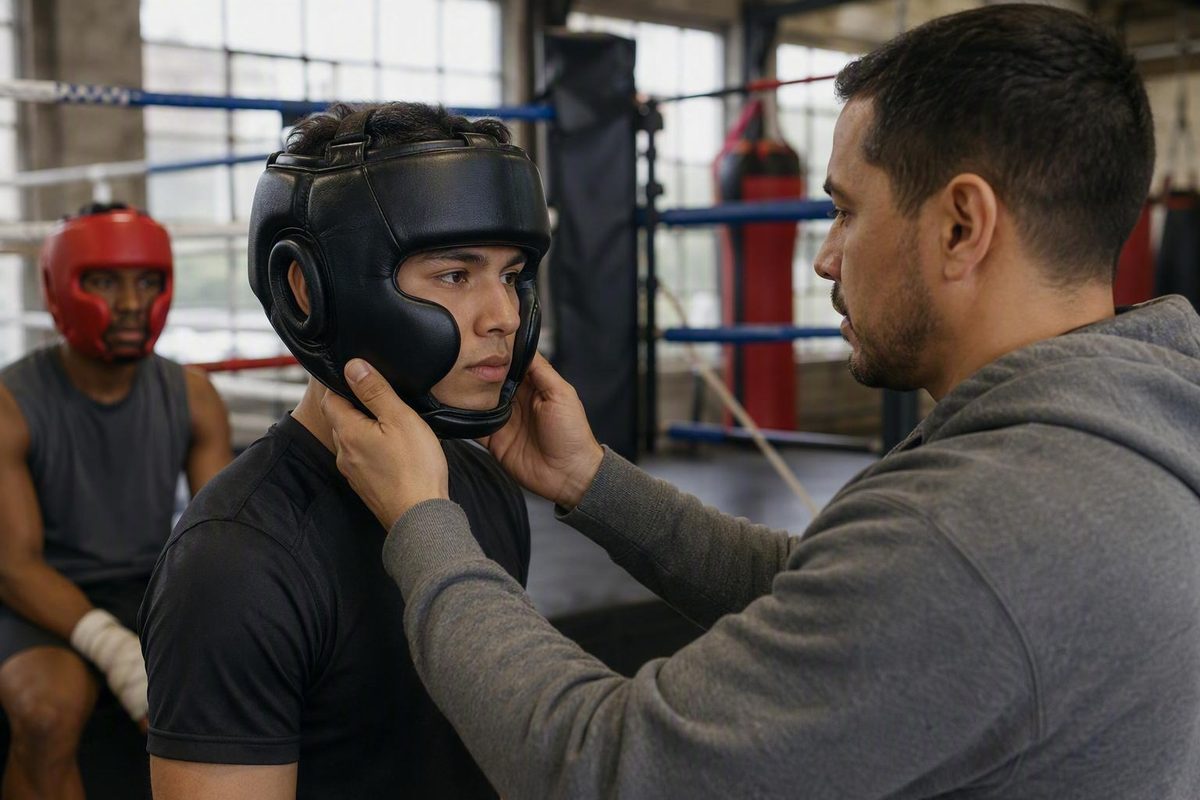
Choose Sting headgear by intended use first, then exact model, model-specific size and current eligibility. For competition, confirm the exact model and color with the governing body and event organizer before buying. For sparring, follow your coach’s requirements and reject any headguard that shifts, obstructs peripheral vision, restricts your jaw or creates concentrated pressure points.
No evidence reviewed for this guide supports naming one Sting model the safest. Nor does the available research establish that boxing headguards prevent concussion or traumatic brain injury; the research concerns boxing headguards generally, not Sting-specific testing (Current Opinion article).
Related: Punch Bag and Mitts: What You Need.
The short answer: choose by use, fit, and current rules
Sting lists open-face, full-face and face-shield headgear. These formats arrange facial coverage differently, but the available sources do not quantify comparative protection, airflow or visibility.
| Buying situation | Models or formats to consider | Confirm before buying |
|---|---|---|
| Amateur competition | Only an exact open-face model currently verified for your event | Governing body, event, division, date, model, color and approval label |
| General sparring | Open-face or full-face headgear | Coach or gym rules, stable fit, sightlines and jaw movement |
| More facial coverage in training | Full-face or face-shield headgear | Gym permission, visibility, communication, comfort and adjustment |
| Uncertain sizing | A model sold with practical exchange terms | Correct chart—especially for Armaplus—and hands-on fit |
| Marketplace or used purchase | A clearly identified Sting model | Authenticity, condition, markings, exact listing details and returns |
Retailer phrases such as “USA Boxing approved,” “World Boxing approved” or “IBA approved” are starting points for verification, not final proof of eligibility.
For sparring, ask your coach which formats the gym permits. Do not assume that open-face, full-face or face-shield headgear is universally suitable. Whatever format you choose, the guard should remain aligned with your skull while preserving peripheral vision and normal, pain-free jaw movement.
Sting headgear models and documented features
On the Sting collection page, Orion Gel and the competition open-face headguard were each shown at $160, Armaplus at $100, Viper X Gel at $175, Evolution Face Shield at $176 reduced from $220, and Viper X Face Shield at $220 (Sting boxing headgear collection). These are changeable source-page snapshots rather than live quotes. The page uses a dollar symbol but does not expressly identify the currency, so confirm the seller’s country, currency and checkout total.
| Model | Format and listed price | Advertised details and approval wording | Sizing and unresolved details |
|---|---|---|---|
| Orion Gel | Open face; $160 | Fight 2 Finish advertises Neo Gel Fusion technology, brow, cheek and temple padding, Japanese Amara lining, a leather outer layer and USA Boxing approval (retailer listing) | Standard chart; approval record, weight, warranty and current stock require confirmation |
| Armaplus | Full face; $100 | Sting labels it “USA Boxing Masters approved” | Separate Armaplus chart; construction, closure, weight and current approval record require confirmation |
| Competition open-face headguard | Open face; $160 from Sting; a white version was shown elsewhere at $169.99 | MSM Fight Shop advertises Gel Fusion padding, Japanese Amara lining, brow, cheek, temple and ear coverage, hook-and-loop adjustment and USA Boxing approval (white retailer listing) | Standard chart; verify the exact product identifier, color and current eligibility |
| Viper X Gel | Full face; $175 | Sting references gel-based technology | Standard chart; materials, closure, weight, approval and comparative test data are not established |
| Evolution | Face shield; $176, reduced from $220 | Listed by Sting as a face-shield model | Standard chart unless product documentation states otherwise; verify shield specifications, replacement parts and permitted use |
| Viper X | Face shield; $220 | Listed by Sting as a face-shield model | Standard chart unless product documentation states otherwise; verify shield specifications, replacement parts and permitted use |
Repeated product cards do not establish additional models, and a product appearing on a collection page does not mean every size and color is available.
The Orion construction details are retailer claims, not independent test results. The same distinction applies to the competition model’s advertised materials and coverage. “Gel Fusion” and “Neo Gel Fusion” should not be treated as interchangeable technical specifications, and no comparative evidence here establishes that one is better.
Promotional terms such as “ultimate,” “unmatched,” “superior” and “maximum protection” are not comparative findings. The sources provide no controlled Sting model rankings, impact-test comparisons or evidence that one design is safest.
How to verify competition approval before buying
Approval means that equipment complies with a particular rules framework. It is not a comparative safety rating, and approval by one organization does not automatically transfer to another.
The product and retailer pages use several distinct labels:
| Product or listing | Advertised approval wording | What the claim establishes |
|---|---|---|
| Orion Gel retailer listing | USA Boxing approved | A retailer claim that still requires comparison with current official requirements |
| Armaplus listing | USA Boxing Masters approved | A model-specific label that should not be treated as general USA Boxing eligibility |
| Competition headguard retailer listing | USA Boxing, IBA and Masters Boxing approved (retailer claim) | Advertised acceptance under several frameworks, without an official registry entry or certification identifier on the page |
| Competition headguard retailer listing | World Boxing approved and designed for World Boxing and England Boxing regulations (retailer claim) | A separate seller’s claim requiring confirmation against current official equipment rules |
These labels are not interchangeable. An older IBA label, for example, does not by itself establish current eligibility under World Boxing, USA Boxing or a national federation. Color can also matter, so verifying a model name alone may be insufficient.
Use this sequence before ordering equipment for competition:
- Record the complete product details. Note the exact model name, color, size, approval label and any product or certification code.
- Define the competition. Identify the governing body, event, date, location, age group, class and division.
- Check the current official equipment rules. Match the exact product and color rather than relying on a similar name, old label or product photograph.
- Inspect the delivered product. Confirm that its physical markings correspond to the model you checked.
- Ask the organizer when anything remains unclear. Obtain confirmation before removing tags or allowing the return window to expire.
Marketplace and retailer titles are not substitutes for an official equipment register. The seller pages above advertise approval but do not show official registry entries or certification identifiers.
Historical event use is also narrow evidence. The USA Boxing FAQ for the 2020 National Championships, published in 2021, said participants could wear their own competition-approved headgear but required finalists to use event-supplied Sting competition headgear (USA Boxing event FAQ). That establishes a requirement for that championship, not present eligibility for another Sting model, color or tournament.
If you cannot match the exact product to the current requirements for your event, do not buy it specifically for competition.
Measure your head and use the correct Sting size chart
Measure your head even if you already own another brand. Retailer fitting guidance recommends the following method:
- Wear your hair as you normally will during training or competition.
- Use a flexible fabric tape.
- Place it level around the widest part of your skull, approximately 2.5 cm above your eyebrows.
- Keep the tape snug without compressing your head.
- Measure twice and record the result in centimeters.
Sting publishes one chart for Armaplus and another for its other headguards. Do not apply the standard chart to Armaplus.
| Chart or model | Size | Centimeters | Inches |
|---|---|---|---|
| All headguards other than Armaplus | S | 50–52 | 19–20.5 |
| All headguards other than Armaplus | M | 52–56 | 20.5–22.1 |
| All headguards other than Armaplus | L | 56–59 | 22.1–23.2 |
| All headguards other than Armaplus | XL | 59–63 | 23.2–25 |
| Armaplus | S | 51.5–55.5 | 20.5–22 |
| Armaplus | M | 55.5–59.5 | 22–23.5 |
| Armaplus | L | 59.5–63.5 | 23.5–25 |
| Armaplus | XL | 63.5–67.5 | 25–26.5 |
These measurements come from the official Sting size guide, which lists customerserviceusa@stingsports.com for additional sizing help.
The difference between the charts is substantial. A 54 cm head measurement maps to M in the standard chart but S in the Armaplus chart.
Boundary measurements require a fit test rather than a universal rule. At 52 cm, the standard chart places the measurement at the meeting point of S and M. Try both sizes where possible and compare:
- Concentrated pressure around the forehead, temples and cheeks
- Rotation during shaking and nodding
- Peripheral sightlines
- Jaw movement
- Chin and throat pressure
- Remaining adjustment range
Do not automatically size up or down based only on circumference or assumed head shape. If you cannot try both sizes, prioritize a seller with clear exchange terms and avoid contact use until the fit is settled.
Run a fit check before sparring
A retailer fitting guide recommends checking brow position, temple and cheek contact, peripheral vision, jaw movement and stability during shaking or nodding (Sting fitting guide). Apply those checks to the closures present on your model; not every Sting headguard necessarily uses the same rear, top and chin system.
- Center the guard. Adjust the rear fitting system, if present, so the headgear sits evenly rather than pulling to one side.
- Set its height. Use the available top adjustment so the brow padding sits about one finger-width above your eyebrows.
- Check the temples. Side padding should cover both temples without obvious gaps.
- Check the cheeks. Cheek sections should contact the cheekbones without pinching.
- Set the chin closure. Where fitted, it should sit snugly under the jaw without pressing into the throat.
- Test peripheral vision. Look left and right without turning your head. Padding should not remove useful sightlines.
- Move your jaw. Open, close and move it from side to side. Movement should remain normal and pain-free.
- Shake and nod. The headgear should move with your skull rather than rotating independently, gapping or falling toward your eyes.
- Repeat after several minutes. Pressure points and slipping may become more obvious after the headguard has been worn briefly.
A headguard is probably too large if it rotates, leaves gaps, hangs loosely around the chin, drops into your vision or needs continual readjustment.
It may be too small if it creates concentrated pressure points, persistent red marks, headaches, restricted jaw movement or pressure against the throat.
If you cannot achieve stability, useful sightlines and comfortable jaw movement at the same time, exchange the headgear before contact training.
What boxing headgear can—and cannot—be expected to do
The available research concerns amateur-boxing headguards generally. It does not test or rank Orion Gel, Armaplus, Viper X Gel, Evolution, Viper X or Sting’s competition headguard.
A peer-reviewed Current Opinion article argues that amateur-boxing headguards reduce facial cuts and lacerations. It cites an observational finding of 60.5 facial cuts and lacerations per 1,000 hours with headguards, compared with 320.4 per 1,000 hours without them, following a rule change (research review).
That comparison should be interpreted cautiously. It is not a Sting product test, and it does not prove concussion prevention. The wider evidence discussed in the article is limited by small samples, inconsistent definitions, surrogate outcomes and rule changes introduced alongside headguard policies. Those factors make it difficult to isolate the effect of headgear.
The practical distinction is:
- Supported general expectation: Headguards can reduce facial cuts and lacerations in amateur boxing.
- Unsupported conclusion: A headguard makes sparring safe or prevents concussion or traumatic brain injury.
- Unsupported model comparison: One Sting model is demonstrably safer than another.
- Marketing rather than evidence: Claims of “ultimate,” “unmatched” or “maximum” protection.
A competition approval label does not change that distinction. Approval addresses compliance with a particular equipment framework; it does not establish superior injury protection.
Boxing remains a contact sport with real risk. Headgear should complement controlled sparring, suitable equipment and direct coaching—not encourage harder exchanges or replace disciplined training. Written guidance cannot assess your individual fit in person or replace a qualified coach.
Pre-purchase checklist
Before ordering Sting headgear, confirm:
- [ ] Exact model name, product code and color
- [ ] Intended format: open face, full face or face shield
- [ ] Coach or gym permission for that format
- [ ] Current eligibility of the exact model and color for the governing body and event
- [ ] Correct use of the standard chart or separate Armaplus chart
- [ ] Seller location and the currency represented by the dollar symbol
- [ ] Current size and color stock
- [ ] Total delivered cost, including tax, shipping and possible import charges
- [ ] Exchange policy, return window, return condition and return shipping costs
- [ ] Whether trying on or training in the item affects return eligibility
- [ ] Product weight, closure configuration, warranty and care instructions where these matter
- [ ] Replacement-shield or other replacement-part availability for applicable models
Marketplace searches can mix Sting products with competing brands or loosely related equipment. Open the individual product page and verify the brand, exact model, size, color and seller. Star ratings, purchase counts, promotional badges and seller descriptions do not establish protective performance, authenticity or competition eligibility.
For used equipment, treat inspection as a general screening step rather than a manufacturer-approved safety assessment. Look for cracks, separation or deformation in the outer shell; compressed or uneven padding; stretched, torn or unreliable closures; and cleanliness problems or persistent odor. Check that model and approval markings remain readable, but do not assume an old label is valid for a current event. If structural integrity is uncertain, do not use the headgear for contact training.
Keep the tags and packaging until you have confirmed size, visibility, stability, comfort and eligibility. The defensible choice is not the model with the strongest promotional language. It is the exact Sting headguard that fits securely, preserves peripheral vision and jaw movement, provides the coverage format permitted by your gym or event, and can be exchanged if it does not fit.
Stop if either test fails: do not buy a competition model whose exact eligibility cannot be verified, and do not spar in headgear that rotates, blocks vision, presses the throat, restricts the jaw or causes pain.