
Learn Boxing Jump Rope Without Rushing the Basics
Choose and size a boxing jump rope, learn the basic bounce and boxer step, fix common faults, and follow a short beginner practice plan.
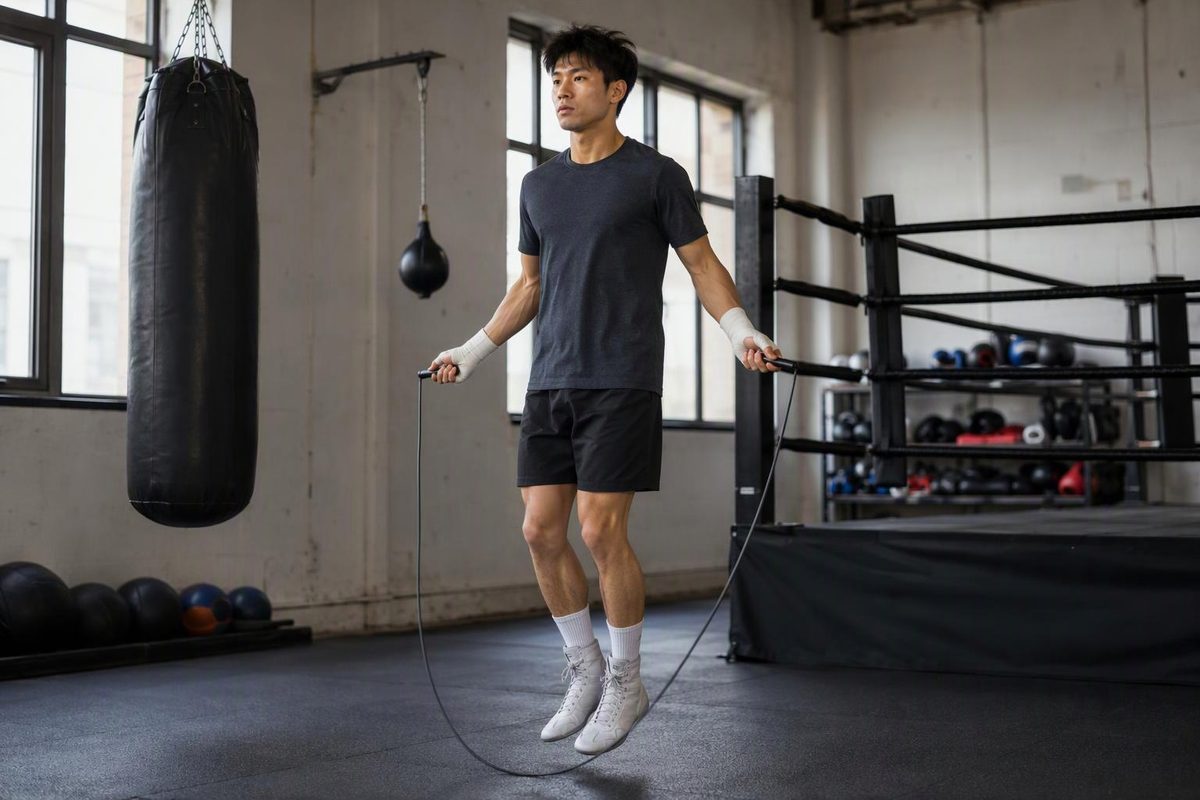
For a beginner, boxing jump rope training starts with a low bounce, small wrist turns and a repeatable rhythm—not fast tricks. Learn to clear the rope comfortably before adding speed or longer rounds.
Skipping is useful conditioning and coordination practice. It is not a substitute for learning to move in a boxing stance. England Boxing’s coaching handbook lists skipping under conditioning and footwork separately under technical skills. Practise both, rather than treating rope rhythm as boxing footwork on its own.
Choose and set up your rope
An adjustable PVC or beaded rope is a sensible starting option. You do not need a heavy rope or a model labelled “professional boxing” to begin. Jump-rope specialist Elite Jumps describes PVC ropes for boxing practice and slightly heavier PVC or beaded options for beginners who want a slower, more noticeable rotation.
For an initial length check:
- Stand on the middle of the rope.
- Pull both handles upward evenly.
- Aim for the handles to reach roughly your armpits, following ACE’s sizing guidance.
Treat that as a starting point, not a universal measurement. Follow your rope’s adjustment instructions and test it before cutting anything permanently. Make sure its sizing chart measures the same thing you are measuring: cable length and total length including handles are not interchangeable.
Wear well-fitting training shoes. Check that the handles are secure and the rope is undamaged. Clear enough space above, ahead and behind you for a full rotation, including clearance from ceiling fans and other people. Use a clean, non-slip floor; these equipment and space checks follow England Boxing’s safety guidance.
Learn the basic bounce first
Start with your feet close together rather than in your staggered boxing stance.
- Posture: Stand tall, look ahead and keep your knees slightly bent.
- Hands: Hold them near your hips, at a similar height on each side. Keep your elbows close and shoulders relaxed.
- Turn: Rotate mainly from your wrists, without making big shoulder circles.
- Jump: Lift only enough to clear the rope. Do not tuck your knees or kick your heels backward.
- Land: Touch down softly on the balls of your feet, keeping the knees relaxed.
These are the central cues in Crossrope’s beginner technique guide. The target is one small bounce per rope turn.
First drill: Place the rope behind your heels. Bring it overhead, make one low jump as it approaches your feet, then stop. Reset and repeat five times. Once single turns feel predictable, link two, then five, then ten.
Checkpoint: You can join ten turns without your hands drifting wider, your jumps getting higher or your landings becoming noticeably louder. If you catch the rope, reset; do not try to rescue the attempt by spinning faster.
Add the boxer step
The boxer step shifts support from one foot to the other. It is not a cross-over trick, and it does not require a high-knee running action.
Learn the pattern without the rope first:
- Make a tiny hop toward your left foot.
- Land mainly on the left foot, then lightly touch the right foot down.
- On the next hop, reverse it: right foot lands, then left foot touches.
- Keep the side-to-side movement small and your head fairly level.
Then add the rope, keeping one turn per hop. This follows the ExRx boxer-step description, which distinguishes it from jumping sideways with both feet landing together.
Try five basic bounces, five boxer steps, then return to the basic bounce. If the rhythm breaks, practise the foot pattern without the rope again. Cross-overs and double-unders—two rope passes during one jump—can wait.
Fix one fault at a time
| What you notice | Correction and drill |
|---|---|
| You jump high or tuck your knees | Put the rope down. Make ten small, quiet bounces, then copy that height for five rope turns. |
| Your shoulders do most of the turning | Reset with elbows near your ribs. Practise single turns with a small wrist action before linking them. |
| The rope catches as your hands spread apart | Return your hands near your hips. Film a short front-view attempt to check whether they drift outward. |
| You keep staring at your shoes | Pick a point ahead at eye level. Do five single-turn resets while looking at it. |
If catches continue with consistent hand position, recheck the rope length. Do not assume every miss means the rope needs shortening.
A short beginner practice plan
Use this as a suggested starting session, not a fitness test:
- 2 minutes: Easy marching and gentle ankle and shoulder movements. Take longer if you need more time to warm up.
- 6 minutes: Six cycles of 15 seconds of basic bouncing followed by 45 seconds of walking or resetting. Single-turn attempts are fine if you cannot yet jump continuously. Do fewer cycles if fatigue starts changing your technique.
- 2 minutes: Put the rope aside. Practise slow forward, backward and sideways steps in your boxing stance using the beginner footwork guide.
Finish with easy walking. Keep rope practice comfortable enough that you can still concentrate on technique. ACE recommends short beginner intervals and gradual progression because skipping is an impact exercise; its guidance also advises checking with a physician if you have concerns about your ability to perform it.
Stop if jumping causes pain rather than pushing through it. Once several sessions feel controlled and comfortable, try 20-second work intervals while keeping the same recovery. Change duration before adding speed or tricks. Your next target is a calm, repeatable set—not an uninterrupted three-minute round.