
Build Balanced Boxing Footwork Before Adding Speed
Learn boxing footwork through a balanced stance, short steps in four directions, common-fault fixes and a simple 10-minute solo progression.
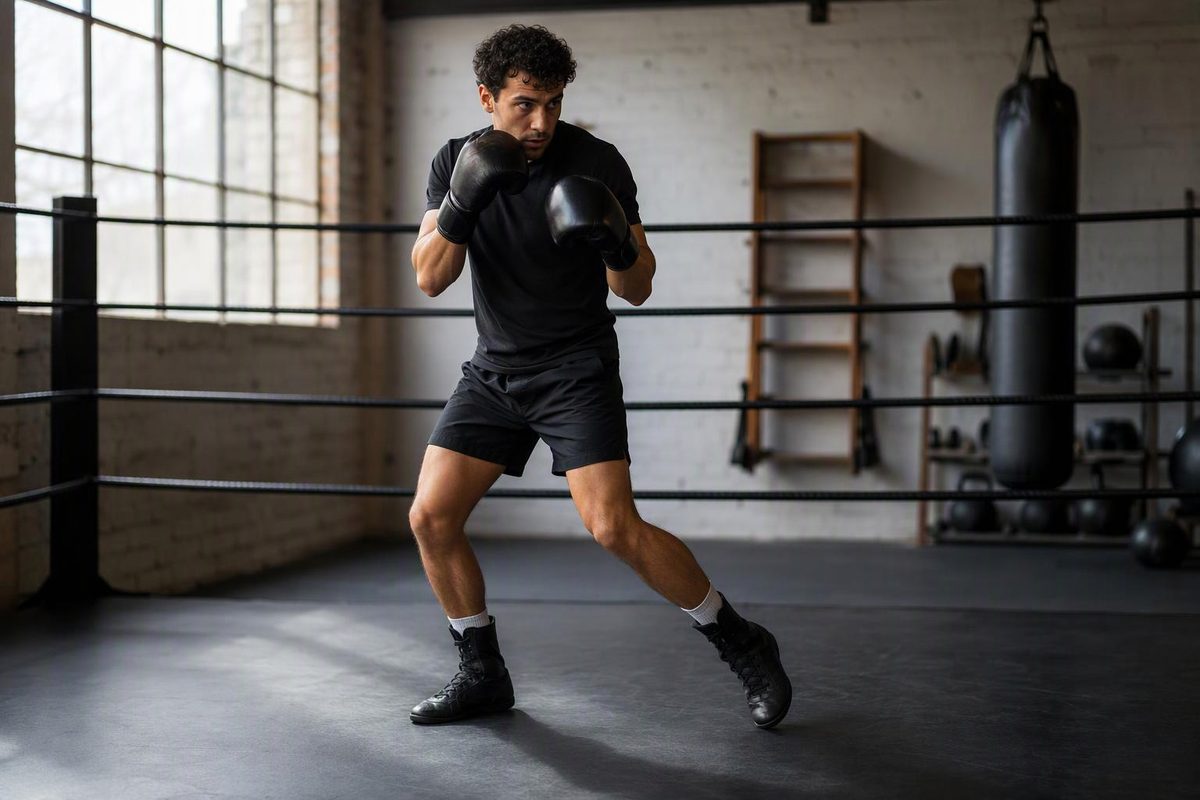
Good boxing footwork moves you into position without taking away your balance. Take short steps, move the foot nearest your direction first and restore your stance before the next action. The goal is to arrive at the right distance and angle with your guard and ability to punch intact—not to dance around the floor or cover the most distance.
Choose your stance and direction; the tool shows which foot moves first.
Which Foot Moves First?
DirectionOrthodox, Moving Forward
Move your lead foot (left) first.
Bring the rear foot (right) forward to restore your stance without letting your feet meet.
Source: England Boxing coaching handbook and Boxing Canada beginner reference manual.
England Boxing’s coaching handbook gives three principles: stay balanced, maintain the length and width of your base, and move quickly in every direction. It recommends short, smooth, sliding movements with minimal bounce. Crossed feet, an overextended stance and a rooted rear heel are listed as common errors (England Boxing coaching handbook).
Start From a Stance You Can Move From
Use the stance taught by your coach. In a basic orthodox stance, the left foot and hand lead. In a southpaw stance, the right side leads.
Before moving, check that:
- your feet have both width and front-to-back depth;
- your knees are soft rather than locked;
- your weight feels supported between your feet;
- your rear heel is light, not pinned to the floor;
- your chin is down and your hands are in guard.
The exact stance will reflect your build and your coach’s system. The practical test is more useful than forcing a fixed measurement: you should be able to step, stop and punch without crossing your feet or making an extra balance correction.
Let the Direction Decide Which Foot Moves First
For basic steps, move the foot nearest the direction of travel, then bring the other foot with it. This prevents your legs from crossing and helps preserve the shape of your stance.
Moving Forward
- Push lightly from the ball of the rear foot.
- Slide the lead foot a short distance forward.
- Bring the rear foot forward by a similar distance.
- Finish in your original stance.
Moving Backward
- Push from the ball of the lead foot.
- Slide the rear foot back.
- Bring the lead foot back to restore your base.
Moving Toward Your Lead Side
Move the lead-side foot first, then let the other foot follow. For an orthodox boxer moving left, the left foot leads. For a southpaw moving right, the right foot leads.
Moving Toward Your Rear Side
Move the rear-side foot first, then restore the stance with the lead foot. For an orthodox boxer moving right, the right foot leads. A southpaw uses the opposite pattern.
Boxing Canada teaches these four elementary movements—advance, retreat, left and right—with short steps, no crossing and no bringing the feet together. Its beginner manual also advises keeping one foot in contact with the floor during basic advances rather than hopping (Boxing Canada beginner reference manual).
Checkpoint: Pause after any step. Your feet should have roughly the same relationship they had at the start. If your stance has become unusually long, narrow or square, shorten the next repetition.
Introduce Angle Changes Carefully
Pivots and exit steps vary in detail, so learn the method used by your coach. For solo practice before that, keep the task simple: take one short side step, turn to face a new line, then restore your stance. Do not try to spin quickly or swing one leg in a wide arc.
Treat the movement as step, turn, reset. Finish with your eyes forward, hands in guard and feet apart. If the turn makes your legs cross, pulls you off balance or leaves your back facing the original line, make it smaller.
Follow This 10-Minute Solo Footwork Drill
Use a clear, non-slip floor. You need no ladder or resistance band.
1. Stance Resets — 2 Minutes
Take your stance, relax and step out of it. Reset repeatedly while looking forward rather than down.
Checkpoint: Both feet land quietly, and you do not need an extra shuffle to feel stable.
2. One-Step Returns — 2 Minutes
Take one step forward, then one back. Repeat from side to side. Stop briefly after every step.
Checkpoint: The same foot should not always initiate movement. The direction determines which foot goes first.
3. Box Drill — 2 Minutes
Move one step forward, one toward your rear side, one backward and one toward your lead side. Reverse the route after several repetitions.
Checkpoint: Finish close to where you started without your stance gradually widening or narrowing.
4. Step and Jab — 2 Minutes
Step into range, stop in a stable stance and throw a relaxed jab. Move out and reset. Do not reach with your head and shoulders while leaving your feet behind.
This stop-then-punch version lets you check your base. Once it is clean, a coach can teach you to time the jab with the step. For the punch mechanics, use The Jab, Built From Stance Up.
Checkpoint: After the jab, you should be balanced enough to move immediately in any direction.
5. Shadowboxing With a Movement Rule — 2 Minutes
Use only simple straight punches. After every one- or two-punch action, take one purposeful step or small angle change. Do not move continuously without a reason.
Checkpoint: Your guard, stance and eye line should survive the transition from moving to punching and back again.
Correct Footwork Faults Before Adding Speed
Your Feet Cross or Meet
Your first step is too long, or the wrong foot is moving first. Slow down and return to single steps.
Your Stance Widens During Every Advance
The rear foot is not following far enough. Put two short strips of tape on the floor to mark your usual front-to-back stance length, then check where both feet finish.
Your Stance Narrows While Retreating
The lead foot is travelling too far during the recovery. Pause after the rear foot moves, then restore only your usual distance.
You Lean Instead of Stepping
You are trying to reach the target without moving your base. Practise stopping just outside range, stepping in, then punching.
You Bounce Too High
Reduce the vertical movement. Think “slide across the floor,” not “jump over it.”
You Look at Your Feet
Practise beside a mirror or film from the front while keeping your eyes at opponent height. Review the recording between rounds rather than watching the floor during movement.
Add speed only after the steps are short, balanced and repeatable. Then vary direction and tempo while preserving your stance. Partner reaction drills, pads and any contact work belong in a boxing gym under qualified supervision.