
Superman Punch: How It Works and Where It Fits in Boxing
Learn how a superman punch works, what USA Boxing rules say about jumping punches, and why beginners should build balanced entries first.
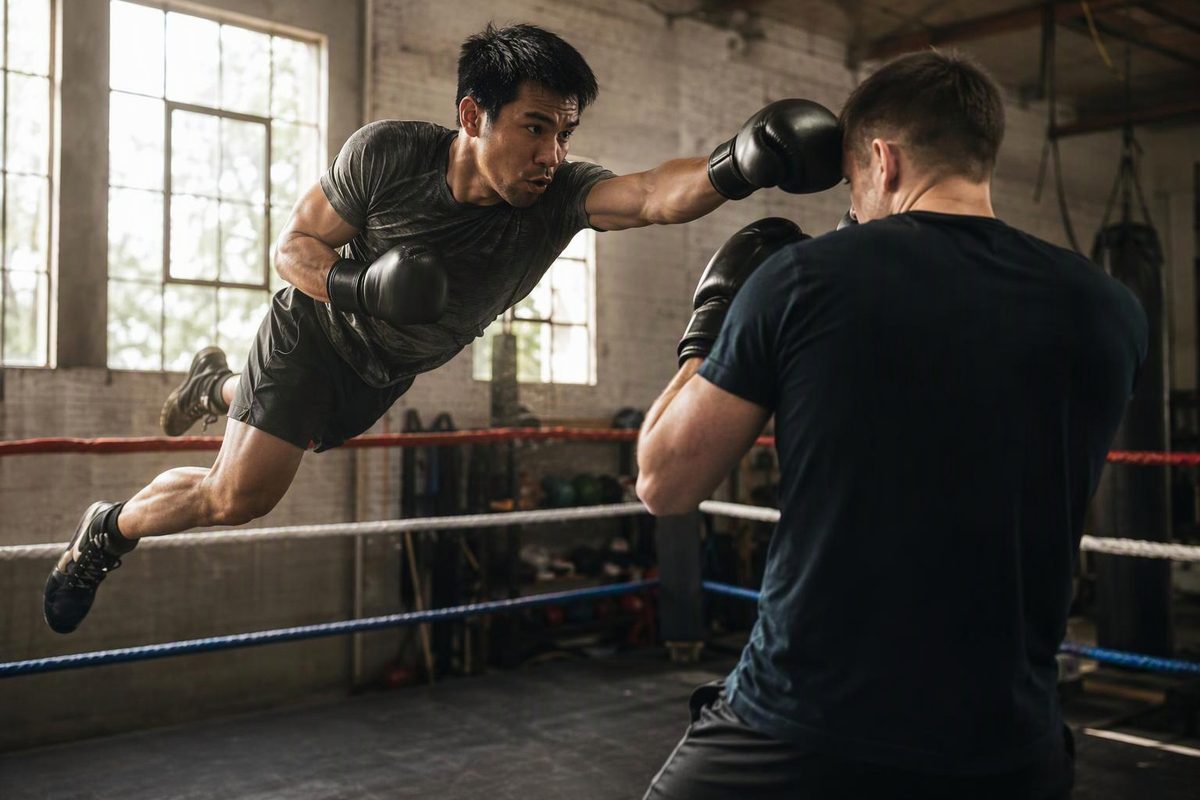
A superman punch combines a kick fake with a hopping straight punch. In the common rear-hand version, the fighter lifts the rear knee as though starting a kick, then sends that leg backward while hopping forward and punching with the hand on the same side.
It is associated with kickboxing and MMA, but boxing beginners usually have a more useful priority: learning to close distance without losing their stance or guard.
How the superman punch works
For an orthodox fighter—left foot forward—the common version uses the right leg and right hand. A southpaw reverses those sides.
The movement has three linked parts:
- Show the kick. Lift the rear knee to suggest a leg attack. This is a feint: a false action intended to draw a defensive reaction.
- Change the attack. Move the raised leg backward while pushing off the lead foot into a short forward hop.
- Throw the straight punch. Extend the rear hand as the leg travels back, then recover the hand and return to a balanced stance.
Movement Living’s superman-punch lesson teaches this rear-leg fake, forward hop and rear-hand cross, emphasizing forward travel rather than a high vertical jump. Keep the non-punching hand protecting your face, and do not force the punching elbow into a locked position during solo practice.
Not every version uses the rear hand. Gabriel Varga’s breakdown of Georges St-Pierre describes a lead-leg, lead-hand variation, delivered from closer range. The defining idea is the leg fake changing into a punch, not simply jumping while throwing a fist. See Varga’s explanation.
Is a superman punch legal in boxing?
Jumping while punching is not expressly prohibited by USA Boxing’s 2026 foul list. That is not blanket permission for every movement called a superman punch: the actual strike and any accompanying contact must still comply with the rules.
Rule 16 prohibits kicking, butting with the foot or knee, hitting below the belt, and several improper striking surfaces, including the open glove, wrist and side of the hand. Under Rules 14.6–14.7, a scoring blow must connect cleanly with the knuckle surface of the glove to the permitted target area, without breaking any rules. A jumping punch cannot become a knee strike or kick on the way in. USA Boxing National Rule Book, effective January 1, 2026, Rules 14 and 16.
For a bout under another governing body or commission, confirm its rules with your coach and the event officials. Gym sparring also requires your coach’s approval; competition legality does not make a technique appropriate for a beginner round.
Why it is not a boxing fundamental
The kick fake has a clearer purpose when kicks are allowed. In Georges St-Pierre’s explanation, he first establishes kicks, then repeats the leg action while switching to a straight punch. A boxing opponent has no legal kick to defend against, so that particular setup loses its usual threat.
The hop also adds a landing to manage. You must recover your guard and base after the punch. For beginners, a short stepping jab offers a simpler way to practise entering range while staying ready to defend.
One common fault, one useful drill
Fault: reaching beyond your base. Your torso pitches forward, your rear foot trails behind, and you need an extra step to regain balance. England Boxing’s coaching handbook identifies leaning into shots and taking oversized strides as balance faults; it recommends short movements that preserve the space between your feet. England Boxing Coaching Handbook, Part 1, footwork section.
Drill: step, jab, freeze, exit. This is a boxing balance drill, not a superman-punch drill.
- Start in your normal stance with your guard up and clear floor space.
- Take a small lead-foot step while throwing a light jab into the air. Let the rear foot follow to restore your usual stance length and width.
- Return the jab to guard and pause.
- Check that your feet have not crossed or come together, then step back with the rear foot first and let the lead foot follow.
Do five slow repetitions. If you need a recovery shuffle before stepping back, shorten the entry. Our beginner footwork guide develops that balanced movement.
If you want to learn the actual superman punch, have a qualified coach check the movement before adding impact or contact. Keep it out of unsupervised partner practice.