
How to Throw a Hook Punch Without Losing Your Balance
Learn a compact boxing hook punch with lead-hand technique, guard and balance checks, common-fault fixes, and a simple solo practice progression.
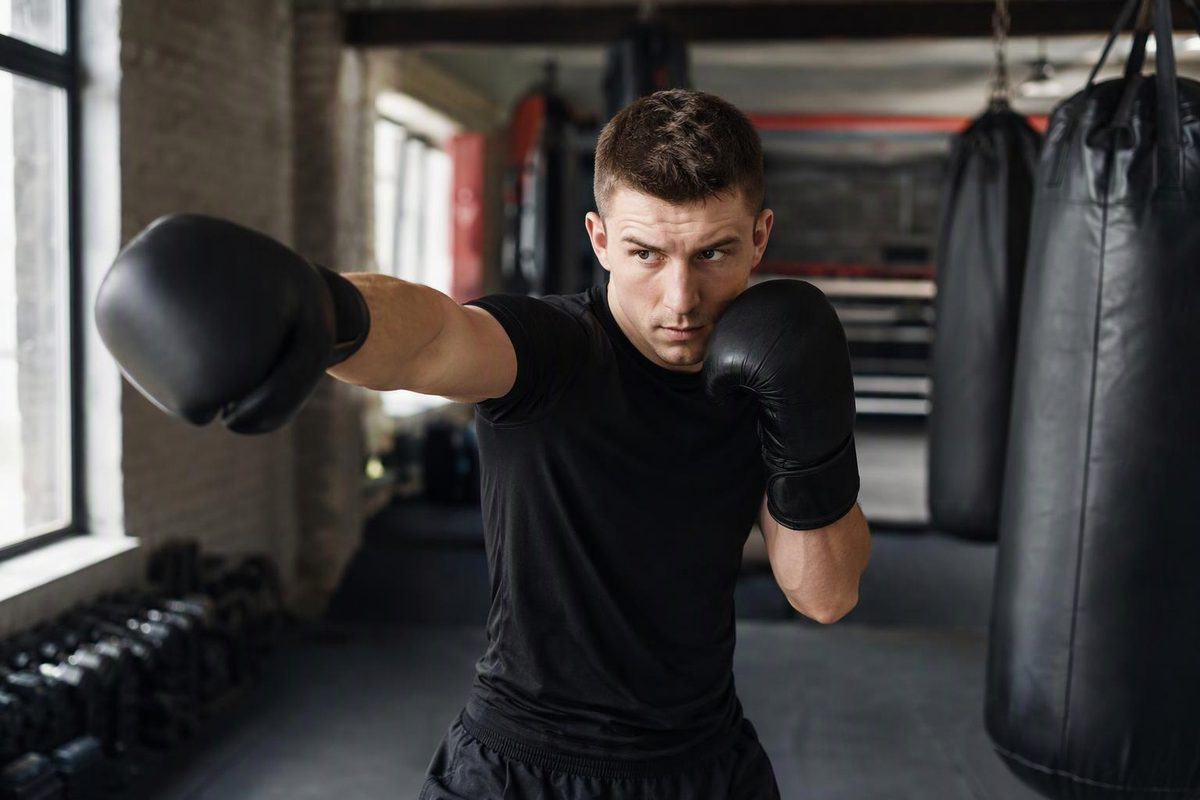
A hook punch travels in an arc with a bent arm, rather than straight toward the target like a jab or cross. The turn of your lower body, hips and shoulders drives the punch; the arm should not swing independently.
You can hook with either hand, to the head or body. Start here with a controlled lead hook to head height in shadow-boxing. In an orthodox stance, your left hand leads; in southpaw, your right hand leads. A right hook is therefore not always a rear-hand punch—see the stance-specific right-hook guide.
Build the lead hook from your stance
Before adding a hook, make sure you can hold your stance and throw straight punches without tipping forward. Review basic punching technique if that foundation is still unsettled.
1. Set your base and guard
Stand with your lead foot forward, feet separated sideways rather than on one tightrope. Soften your knees, keep your chin tucked and look ahead. Bring both hands into guard, with the rear hand beside your cheek.
Choose an imaginary target close enough to reach with a bent arm. Do not stretch toward it.
2. Turn the body, not just the arm
Push through the lead foot and turn your hips and shoulders toward the punch. Let the lead foot pivot inward on its ball so the heel can turn outward with the hips. For an orthodox lead hook, the body turns to your right; for a southpaw lead hook, it turns to your left.
Allow your weight to settle toward the rear leg without leaning backward. Keep the turn small enough that your feet still support you. Boxing Canada’s coaching manual teaches the lead hook through hip-and-shoulder rotation, an inward front-foot pivot and a high rear-hand guard. Boxing Canada, section 3.5
3. Carry the bent arm across
As your body turns, bring the lead fist around in a compact arc. Treat the turn and arm movement as one coordinated action, not two separate stages. For this mid-range head hook, use an approximate L-shaped arm, with the elbow near fist height and the palm facing down as you reach the imaginary target. My Boxing Coach’s mid-range hook instruction
Keep the wrist aligned with the forearm. On a bag, aim to contact with the knuckle area of the glove—not its palm or side. The elbow angle and hand position can vary with range and target; this palm-down version is a starting point, not a rule for every hook. Paul Carroll’s hook technique guide
Do not pull the fist behind you to wind up. Your other hand stays beside your cheek throughout.
4. Recover immediately
Return the punching hand to guard and reset your stance. In shadow-boxing, stop the arc under control rather than letting a missed punch spin you around.
Checkpoint: after the hook, can you take one short step backward without first untangling your feet or catching your balance? If not, reduce the turn and speed.
Common faults and simple fixes
My Boxing Coach identifies dropping the opposite hand, using only the upper body and chasing excessive power as common lead-hook faults. Use these slow drills to make those errors visible. Lead-hook fault guidance
| Fault you can observe | Corrective drill |
|---|---|
| Rear hand drops as the hook travels | Throw five slow hooks in front of a mirror. Watch only the rear glove: it should stay beside the cheek. |
| Arm swings independently of the body | With both hands in guard, practise five small foot-and-hip turns without punching. Then add the bent arm, carrying it with the turn rather than swinging it separately. |
| Hook pulls you off balance | Throw one slow hook, recover your guard, then step back. Reset after every repetition; shorten the arc if you wobble. |
Progress from single hooks to a combination
Start with five deliberate single hooks, pausing to check your guard and balance after each. Then practise a slow jab–cross–lead hook, returning to guard before repeating. The cross gives you a natural rotation to reverse into the hook; do not add a separate wind-up.
Boxing Canada teaches this three-punch sequence and recommends learning combination patterns slowly before moving to controlled bag work and coach-led pads. Combination progression, section 3.9, pages 45–48
Keep early bag practice light, with wraps and suitable boxing gloves. Ask a coach to check your range and wrist alignment before increasing force or adding body hooks. Stop if punching causes pain. Partner contact and sparring belong in supervised boxing training; they are not the next step in a solo drill. Contact-practice precautions