
Throw a Balanced Right Hook and Recover Your Guard
Build a compact right hook with stance-specific guidance, head and body mechanics, balance checks, and beginner drills that correct three common faults.
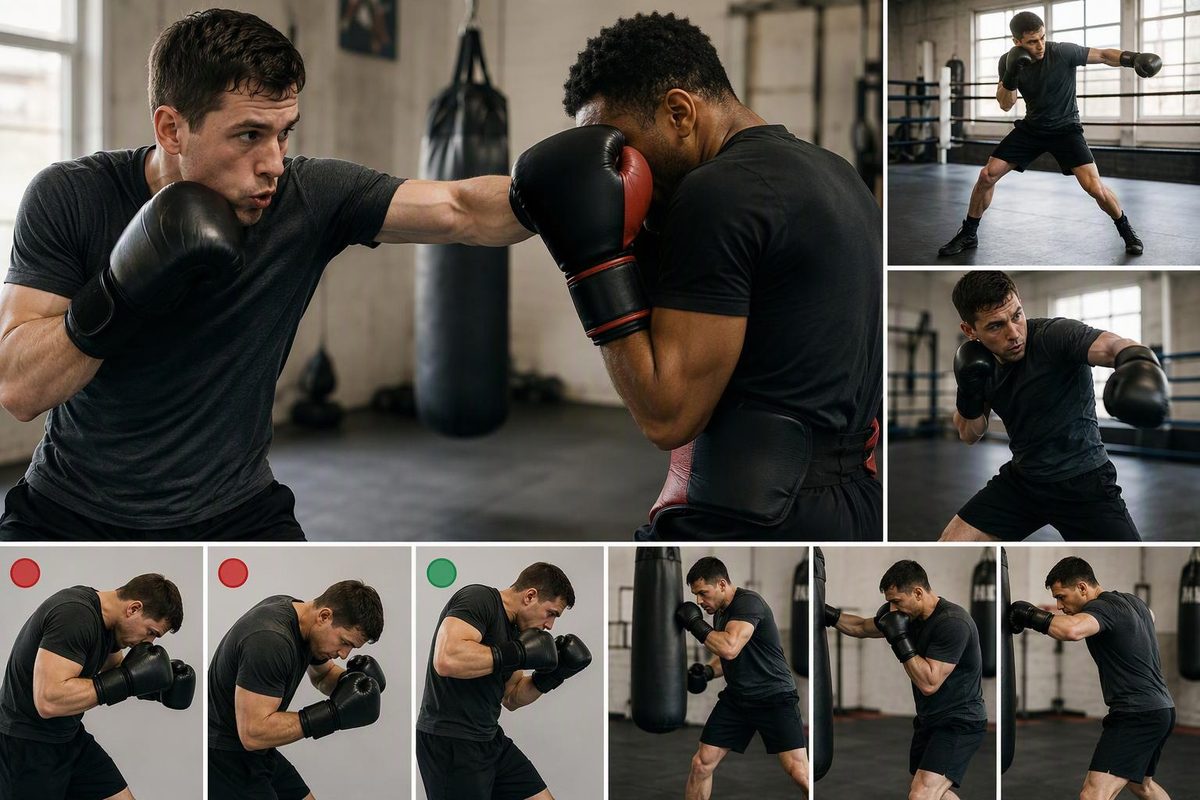
A right hook is a bent-arm punch that travels in an arc rather than straight like a right cross. For a basic orthodox right hook, turn your rear foot, hip and shoulder together, carry the glove through a compact arc, keep your left hand guarding and return promptly to stance. Do not wind up or reach beyond your balanced range.
“Right” names the hand—not its position in your stance. In orthodox, with your left foot forward, the right hook is a rear-hand punch. In southpaw, with your right foot forward, it is a lead-hand punch. These use different starting mechanics, so check the stance before copying a demonstration. Boxing coach Paul Carroll explains this distinction.
The steps below teach a basic orthodox rear right hook to head height. Practise the movement without contact first.
Choose your stance, target and sticking point to get the appropriate practice cue.
Right-Hook Practice Cue
Rear Right Hook to Head Height
From guard, turn your rear foot, right hip and shoulder together. Carry a bent arm through a compact arc, keep your wrist straight and your left glove near your cheek, then return to guard.
Practice: Shadowbox one slow hook, recover and take a small step backwards. If you need a catch-up step, shorten the arc and reduce the turn.
Start without contact. Roughly 90 degrees is a starting elbow angle for this mid-range head hook, not a rule for every hook.
Sources: Paul Carroll’s hook guide, Fran Sands’s head/body hook guides, and the AIBA Coaches Manual, linked in the article. These are practice cues, not a readiness assessment.
Build the Orthodox Right Hook From Your Stance
Set Your Base and Bent-Arm Range
Start with your left foot forward, feet staggered, knees soft and right heel lightly raised. Keep both gloves up and your chin gently tucked.
Choose a distance where a bent arm can reach the target without leaning. Start with a mid-range hook rather than a long, sweeping variation. If you are too far away, adjust with your feet before punching—not by stretching your arm. England Boxing makes balanced footwork and getting into position the foundation of effective punching in its coaching handbook.
Turn Your Body and Arm Together
From guard, push through the ball of your right foot and let the rear heel turn as your right hip and shoulder rotate towards the target. Keep the turn controlled; do not spin around your front leg or force a twist over a planted foot.
As you rotate, carry your bent right arm into a compact arc. Do not pull the glove backwards to wind up. Coach Fran Sands’s mid-range right-hook guide describes the rear-foot drive, hip rotation and bent-arm delivery. Think of these as one coordinated movement, not a body turn followed by a separate arm swing.
Support the Fist With a Straight Wrist
For a basic mid-range head hook, an elbow bend of roughly 90 degrees is a useful starting point. Bring the forearm approximately level as the glove reaches the target. Sands teaches a palm-down position for this variation. Keep your wrist straight and present the knuckle surface of the glove, rather than slapping with its inside edge.
The AIBA Coaches Manual, rear-arm hook section teaches a bent arm near 90 degrees, a guarding lead hand and quick recovery. The angle is not fixed for every hook: Sands distinguishes short-, mid- and long-range hook shapes.
Keep Your Left Hand Up and Recover
Keep your left glove near your cheek, eyes on the target and chin down. Breathe out briefly as you punch.
Bring the right glove promptly back to guard and regain your ready stance. Practise this recovery even when shadowboxing: a missed hook should not leave you facing away or needing a catch-up step to stay upright.
Balance checkpoint: after a slow hook and recovery, take a small step backwards while keeping your stance. If you cannot do that immediately, shorten the arc and reduce the turn.
Lower Through Your Knees for a Body Hook
For an orthodox right hook to the body, lower your level through your knees instead of folding forward at the waist. Keep your eyes up and left glove guarding as you rotate into a body-height target. The punching path may angle upwards rather than remain horizontal. Sands’s right-hook-to-the-body guide explains the knee bend, rear-foot drive and return to stance.
Learn the target and alignment on coach-held pads before adding force. Do not test body punches on an unprepared partner.
Correct Three Common Right-Hook Faults
| Fault | What to Watch | Correction Drill |
|---|---|---|
| Winding up | Right glove moves backwards first | Perform five slow hooks from guard in a mirror; watch the glove’s first movement and reset. |
| Reaching or over-rotating | Falling forwards or turning past the target | Hook, recover, pause and take a short backward step. Reduce range or effort until no extra balancing step is needed. |
| Dropping the left hand | Free glove drifts during the turn | Perform five slow hooks with the left glove lightly beside your cheek. Check both hands. |
Keep these drills slow enough to see the fault. The balance drill checks the recovery as well as the punch: completing the arc is not enough if you cannot move afterwards without catching yourself.
Progress From Shadowboxing to Light Contact
After warming up, try three one-minute blocks with easy rest between them. Shorten the blocks if control deteriorates.
- Shadowboxing: single right hooks, with a deliberate guard reset.
- Balance: hook, recover, small backward step, reset.
- Optional light bag work: single hooks at a suitable bent-arm distance. Skip contact if you cannot maintain alignment and control.
Use wraps and suitable gloves for bag or pad work, and stop if punching causes pain; Carroll’s hook guide gives these contact-practice precautions. Partner contact belongs in supervised boxing training.
Once single hooks stay balanced, add a jab before the hook, checking your distance again: a hook is not a direct replacement for a long cross. Use the beginner boxing combinations guide to build sequences without losing guard recovery.