
Two Similar Striking Sports, One Ruleset-First Way to Choose
Muay Thai fits elbows, knees and active clinching; suitable kickboxing programs favor combinations, angles and K-1 competition.
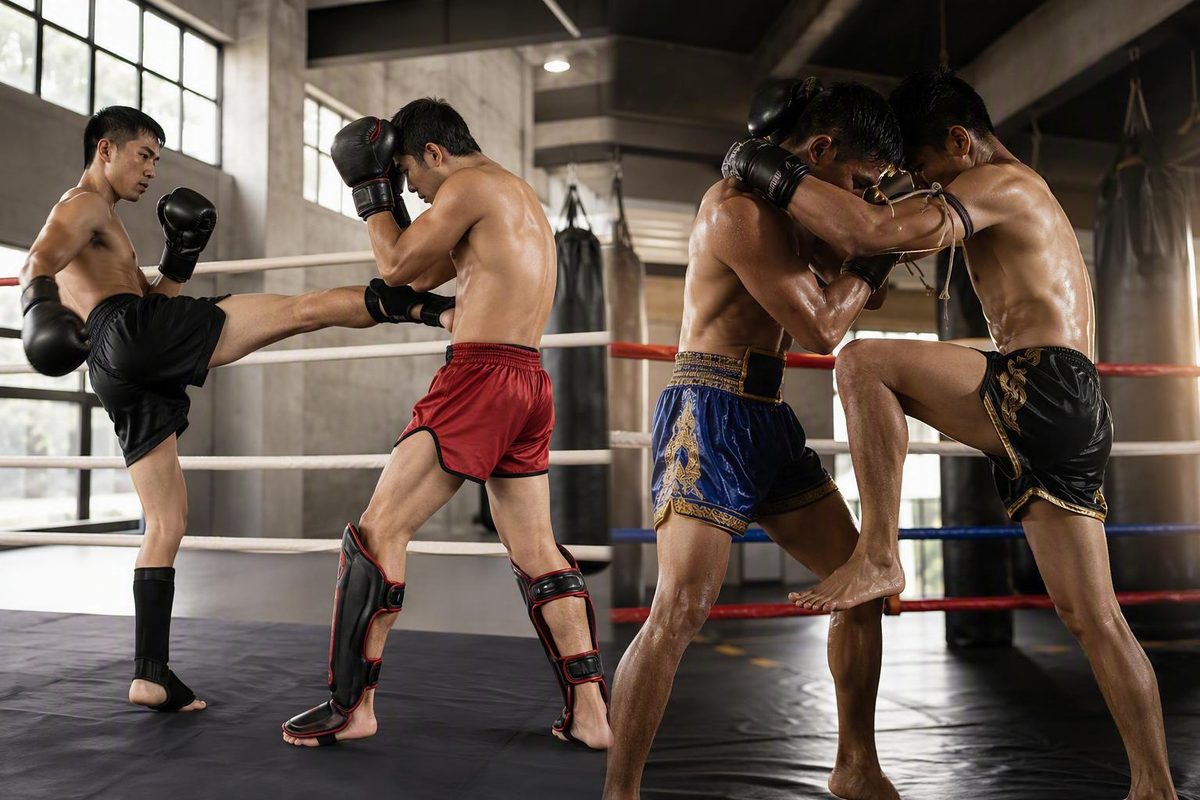
The short answer: similar foundations, different rules
Kickboxing and Muay Thai share substantial striking fundamentals, but they are not interchangeable terms.
Muay Thai is a specific Thai combat sport based on stand-up striking and clinching. It is commonly called the Art of Eight Limbs because it uses punches, kicks, knees, and elbows. Kickboxing is a broader category covering multiple competitive rulesets and recreational class formats. A fitness kickboxing class, a traditional American kickboxing program, and a K-1-style competition team may therefore teach materially different activities.
That distinction makes a “kickboxing vs Muay Thai” comparison useful only after kickboxing has been defined. This guide considers three formats separately:
- Muay Thai
- K-1-style kickboxing
- Traditional American kickboxing, as that label is commonly used
Among those three broad descriptions, Muay Thai commonly includes the widest selection of striking tools and the most extensive active clinch work. K-1-style kickboxing generally uses punches, kicks, and knees, but excludes elbows and limits the clinch. Traditional American kickboxing is commonly organized around punches and kicks, although legal targets and low-kick rules vary. Practitioner discussions likewise emphasize that “kickboxing” can refer to materially different rulesets rather than one universal sport (Martial Arts Stack Exchange).
The familiar shorthand says kickboxing uses four limbs while Muay Thai uses eight. It is a useful introduction, not a dependable universal rule. Some kickboxing formats permit knees, low kicks, or brief clinching.
Ruleset caveat: This article summarizes tendencies described in the available comparison sources; it is not an official rulebook. The current rules of the applicable sanctioning body, promotion, event, and gym take precedence. Before sparring or competing, ask which exact rules are in force.
Rules comparison: Muay Thai, K-1, and American kickboxing
The table is a limited orientation to commonly described formats—not a definitive statement of current competition rules. Each label means:
- Generally allowed: Characteristic of the source-described format.
- Generally restricted: Usually available only within defined limits.
- Generally prohibited: Commonly excluded from the source-described format.
- Ruleset-dependent: Too variable to assume without checking the organization or event.
| Technique | Muay Thai | K-1-style kickboxing | Traditional American kickboxing |
|---|---|---|---|
| Punches | Generally allowed | Generally allowed | Generally allowed |
| Kicks | Generally allowed | Generally allowed | Generally allowed |
| Low kicks | Generally allowed | Generally allowed | Ruleset-dependent |
| Knees | Generally allowed | Generally allowed | Ruleset-dependent |
| Elbows | Generally allowed | Generally prohibited | Generally prohibited |
| Active clinching | Generally allowed | Generally restricted | Ruleset-dependent |
| Kick catches | Ruleset-dependent | Generally restricted | Ruleset-dependent |
| Sweeps or dumps | Ruleset-dependent | Generally prohibited | Ruleset-dependent |
| Throws | Generally restricted | Generally prohibited | Ruleset-dependent |
These classifications summarize the formats as described by comparison sources, particularly the source-described distinction between Muay Thai and K-1-style rules. They should not be applied to an event without consulting its current official rules (Extreme MMA).
Muay Thai
Muay Thai generally permits punches, kicks, knees, elbows, and active clinching. Many rulesets also allow kick catches and specified sweeps or dumps, but the legality and permitted follow-up vary. “Allowed under Muay Thai rules” never means unrestricted grappling: the applicable rules determine which off-balancing actions are legal.
The clinch can be an active phase of the fight rather than merely a pause. The source-described format allows fighters to contest posture and position, attack with knees, turn an opponent, and attempt permitted off-balancing actions while productive action continues. A referee may still intervene when the action stalls or becomes illegal.
K-1-style kickboxing
The K-1-style format described in the supplied comparison evidence generally allows punches, kicks, and knees while prohibiting elbows. Clinching is restricted or separated more quickly, and catches, throws, and sustained upper-body control are also limited or excluded.
Because knees can be legal, calling K-1 a pure “four-limb” format is incomplete. The important questions are not only which strikes are allowed, but how they may be set up, how long contact can continue, and what a fighter may do after controlling an opponent.
Traditional American kickboxing
Traditional American kickboxing is commonly described as a punch-and-kick format without elbows. Beyond that broad description, the label is not precise enough to support one universal rules summary.
Accordingly, two gyms advertising “kickboxing” might provide very different training:
- Non-contact bag combinations for fitness
- Above-the-waist full-contact competition
- Low-kick competition
- K-1-style combinations with knees
- A hybrid curriculum influenced by Muay Thai
Before enrolling, ask:
- Which ruleset does this class teach?
- Are knees and low kicks included?
- Is clinching taught, and how long can it continue?
- Are elbows omitted, limited to pads, or included in controlled partner drills?
- Which rules govern sparring?
- Which sanctioning body or promotion hosts the gym’s competitors?
The answers matter more than the word printed on the timetable.
How the rules change range, scoring, and fight strategy
Shared techniques do not create identical tactics. Rules determine which threats exist at each distance, what can happen after a strike, and what judges may reward.
Long range
Both Muay Thai and kickboxing use long-range kicks. In the commonly described Muay Thai format, athletes also account for shin contact, catches, and legal follow-ups after a catch. K-1-style fighters use low kicks too, but catch-and-sweep sequences are more restricted in the source-described format.
That changes the decision tree. Where catches are excluded but immediate punching counters are available, the defensive problem is different.
Hypothetical exchange: Fighter A throws a body round kick. Under a Muay Thai ruleset, Fighter B might catch it and use a permitted counter or off-balancing action. Under a kickboxing ruleset that restricts catches, Fighter B might instead block, evade, or answer with punches and a low kick.
Neither response is mandatory. The example only illustrates how legal follow-ups affect tactical choices.
Punching and mid-range
Source-described K-1-style tactics commonly emphasize linked punch-kick combinations, angles, pressure, low kicks, and knees. Punches may create openings for a body kick, low kick, or knee.
Muay Thai athletes can use the same tools, but they must also account for legal elbow entries. As a coaching inference, that additional threat can change how a fighter manages distance, recovers the guard, and exits after punching.
Hypothetical exchange: Fighter A throws a jab-cross-hook. A K-1-style continuation might be a low kick as Fighter B covers. That finish remains possible in Muay Thai, but Fighter B may also have an elbow counter available if the distance and event rules permit it.
Clinch range
The clearest tactical split often appears when fighters establish upper-body contact. In the source-described Muay Thai format, active clinching can continue into positional control, knees, turns, and permitted off-balancing actions. Under many kickboxing formats, the referee separates the fighters sooner or permits only limited action before release.
A Muay Thai athlete may therefore enter the clinch as an offensive phase. A kickboxer under restrictive rules has less reason to invest in a position that will be broken quickly.
Hypothetical exchange: Fighter A enters behind punches and the athletes tie up. Under Muay Thai rules, they might continue contesting posture while attempting knees and turns. Under a K-1-style event, only brief action may be permitted before separation.
Scoring changes priorities
Scoring is organization-specific. It should not be reduced to “Muay Thai rewards power while kickboxing rewards volume.”
One comparison describes Muay Thai judging as emphasizing effectiveness, balance, power, and control, while its account of K-1-style kickboxing emphasizes clean strikes, combinations, aggression, pressure, and ring generalship. These are source-described tendencies, not universal judging formulas (Extreme MMA).
Depending on the criteria, a competitor may prioritize:
- Remaining visibly balanced after striking
- Producing a clear effect rather than light contact
- Connecting several strikes in a scoring sequence
- Maintaining effective pressure
- Controlling posture and position in the clinch
- Exiting at an angle rather than remaining available for a counter
Current event rules can change the value of a catch, dump, clinch knee, spinning attack, combination, or forward movement. Competitors should read the applicable criteria and ask their coach how judges and referees apply them.
Stance, movement, kicking, and defense: tendencies rather than laws
Legal elbows, low kicks, catches, and longer clinch exchanges can influence stance, guard, balance, distance, and defense. They do not create one compulsory posture or rhythm.
Stance and balance
Muay Thai is often described as relatively measured and balance-conscious, with athletes prepared for close-range exchanges, counters, catches, and clinching. K-1-style kickboxing is often described as more angle-based, mobile, and combination-oriented at mid-range.
These are recurring observations, not fixed laws. Both sports include mobile fighters, pressure fighters, patient counterfighters, and combination-heavy athletes.
Guard and defensive choices
Adding or removing legal techniques changes the problems a guard and stance must solve. A defensive choice developed for boxing or one kickboxing format may therefore need adjustment when elbows, knees, low kicks, catches, or sustained clinching enter the rules.
The reverse is also true: a habit suited to Muay Thai may not be optimal for every kickboxing event or athlete. Coaches may adjust stance, weight distribution, guard, or movement to suit the available techniques and tactical priorities. These are context-dependent coaching decisions, not proof that one style has a superior stance.
Kicking mechanics
Muay Thai round kicks are commonly described as emphasizing hip rotation and shin contact. Kickboxing schools may teach a wider range of snapping and swinging mechanics, with contact made by the foot or different areas of the shin. These descriptions overlap and vary with the gym, target, distance, and purpose (Ronin Athletics).
A fast scoring kick and a committed low kick do not have to look identical, even when performed by the same athlete. It is therefore unhelpful to call one sport’s kicks inherently faster, simpler, more artistic, or more powerful. Technique should be judged in relation to the task and rules.
Fundamentals remain fundamental
Beginners in either discipline need:
- A stable stance
- Controlled weight transfer
- Reliable guard recovery
- Appropriate distance
- Timing
- Visual awareness
- Efficient movement
- The ability to strike without losing balance
What beginners are likely to learn in each class
Neither discipline is universally easier for a complete beginner.
Kickboxing can feel simpler when a class starts with a narrower punch-kick framework. Fewer immediate options may let students focus on stance, basic punches, a small number of kicks, and simple combinations.
Muay Thai can feel broader because its eventual curriculum may include knees, elbows, clinch positions, catches, checks, and defenses against those tools. But a broader ruleset does not prove that every recreational class teaches every technique deeply or introduces everything at once.
Conversely, “kickboxing” does not guarantee an easy introduction. A K-1-oriented class can involve demanding boxing combinations, low-kick defense, knees, angles, and tactical drills. A fitness class may be physically accessible but teach little partner application, while a competition class may assume prior experience.
What the classes may share
Common activities include:
- Shadowboxing
- Pad work
- Heavy-bag work
- Partner drills
- Footwork practice
- Conditioning
- Defensive exercises
- Technical or open sparring, when appropriate
Muay Thai classes may include dedicated clinch rounds and more extensive knee or elbow work. A kickboxing class may devote more time to punch-kick sequences, movement, and combinations. Class structure remains local, so do not assume that sparring, clinching, or hard conditioning begins in the first session.
The environment matters more than the label
A structured kickboxing class with clear demonstrations, supervision, and progressive drills is a better beginner environment than a chaotic Muay Thai class—and vice versa. One beginner-oriented comparison similarly presents coaching and class structure as more important than the style name, although this is practical gym guidance rather than a measured finding (Team Black MMA).
During a trial class, ask:
- How are stance, movement, and guard introduced?
- In what sequence are punches, kicks, knees, elbows, and clinching added?
- How are beginners paired for partner drills?
- Is clinching taught, and how often?
- When are students invited to spar?
- Is sparring optional?
- How are partners matched for size, skill, and intended intensity?
- Can students decline hard contact without pressure?
- How does the coach correct mistakes?
- What equipment is required?
Look for a clear progression from explanation to controlled repetition and then to less predictable practice. A first class may be challenging, but it should not be disorderly. Favor a gym where questions are welcome, partners cooperate, contact is controlled, and beginners are not expected to prove their toughness.
Which should you choose for fitness, competition, or self-defense?
There is no overall winner. The better choice depends on your goals, preferred training experience, and the quality and accessibility of local instruction.
For general fitness
Both kickboxing and Muay Thai can provide demanding full-body training through footwork, pad rounds, bag rounds, striking drills, and conditioning.
Choose a class you can attend regularly. An excellent program that is impractical to reach or unpleasant to attend may be less useful than a strong nearby alternative.
Also distinguish fitness kickboxing from combat-sport training. A non-contact class can be a worthwhile workout without teaching partner timing, defense under pressure, clinching, or competition preparation.
For elbows, knees, clinching, and catches
Muay Thai is the more direct fit if you specifically want to study:
- Elbow technique
- A broad range of knee attacks
- Sustained active clinching
- Posture and position fighting
- Kick catches
- Permitted sweeps or dumps
- Close-range striking transitions
Confirm that the gym actually teaches these elements. The label alone does not guarantee regular clinch practice or a competition-oriented curriculum.
For combinations, angles, and K-1 competition
A suitable kickboxing program is the more direct fit if you prefer:
- Fast punch-kick combinations
- Mid-range pressure
- Angle changes
- Low-kick combination work
- Knees within a restricted-clinch format
- K-1-style competition
A cardio kickboxing class is not automatically a route into K-1 competition. Ask whether the gym trains and fields athletes under the rules you want to learn.
For competition
Start with the available event pathway and work backward.
Find out which amateur events operate in your area, which rules they use, and which local gyms prepare athletes for them. Competition preparation should match the event. Prolonged clinch sequences have limited value if the referee will separate them immediately; neglecting clinch defense is a significant gap when active clinching is legal.
For MMA crossover
Both disciplines can develop transferable stand-up skills, including striking, timing, balance, distance management, and practice against resistance. This comparison does not establish that either is categorically better for MMA.
If MMA is your goal, assess how a gym adapts its striking to MMA rather than relying on the kickboxing or Muay Thai label alone.
For self-defense
Muay Thai may expose students to a broader close-range toolkit because it commonly includes elbows, knees, clinching, and balance disruption. That technical breadth does not establish universally better real-world outcomes.
Self-defense also involves awareness, avoidance, escape, and legal context—areas neither competition ruleset reproduces fully.
If both styles appeal equally, use a simpler rule: choose the safer, better-coached, more accessible gym.
Cross-training and switching between the sports
Kickboxing and Muay Thai share enough punching, kicking, timing, balance, and distance management for prior experience to remain useful when the rules change.
A practitioner transition ranking places kickboxing among the closest backgrounds for moving into Muay Thai, identifying elbows and clinching as major adjustments. That is a practitioner assessment, not a measured guarantee (Jonesly MMA).
Kickboxing to Muay Thai
A kickboxer entering Muay Thai may need to learn or expand:
- Elbow offense and defense
- Sustained clinch positions
- Posture control and hand-fighting
- Knees from the clinch
- Kick catches
- Permitted sweeps or dumps
- Defense against catches and off-balancing
- Balance after committed kicks
- Entries and exits when elbows are available
Stance, rhythm, guard, and movement may also need adjustment. The required changes depend on the athlete’s previous ruleset and habits.
Muay Thai to K-1-style kickboxing
A Muay Thai athlete entering K-1-style competition may need to:
- Remove elbows from automatic follow-ups
- Release restricted clinches sooner
- Modify knee entries and tie-ups
- Avoid illegal catches, sweeps, or dumps
- Adapt combination choices and pace
- Adjust movement to the available scoring opportunities
- Learn the event’s criteria for clean strikes, pressure, and ring control
A legal response in Muay Thai can become a foul or wasted action elsewhere. The previous training was not wrong; it was optimized for another ruleset.
Avoiding cross-training confusion
Cross-training does not automatically create harmful technical conflicts.
Tell both coaches that you cross-train. During drills, state the rule frame explicitly:
- Muay Thai rules
- K-1-style rules
- Boxing-only round
- Kicks but no knees
- Technical clinch
- No catches or sweeps
This keeps legal follow-ups clear while allowing shared fundamentals to transfer.
Safety and how to evaluate a gym before joining
Both kickboxing and Muay Thai are contact sports with real risk. The supplied evidence does not establish that one is inherently safer.
- Non-contact shadowboxing
- Pad or bag work
- Cooperative partner drills
- Controlled technical sparring
- Hard or open sparring
- Amateur competition
- Professional competition
A person attending a non-contact fitness class does not face the same exposure as a competitor. Even within one gym, contact frequency and intensity can vary.
What the Muay Thai injury study does—and does not—show
A questionnaire-based study interviewed 152 Muay Thai participants at gyms and competitions in the United Kingdom and at an event in Holland. Lower-extremity injuries were the most commonly reported location, while soft-tissue trauma was the most commonly reported injury type across experience groups (PubMed).
The study included only 19 beginners and 20 women. It gathered injury information through interviews rather than prospective medical surveillance, and its abstract did not report exposure hours. It also did not enroll a concurrent modern kickboxing comparison group (PubMed).
The study therefore cannot establish whether Muay Thai is safer or more dangerous than K-1-style or American kickboxing. Its subgroup rates should not be used to claim that beginners inherently face greater causal risk.
Gym-evaluation checklist
The following are practical questions for assessing a gym, not a validated medical or federation safety standard.
Beginner supervision
- Does the coach know who is new?
- Are foundational movements demonstrated clearly?
- Is someone monitoring beginners during partner drills?
- Are unsafe mistakes addressed promptly?
Progressive contact
- Do drills begin cooperatively before speed or resistance increases?
- Are the purpose and contact level of each drill explained?
- Does intensity increase deliberately rather than unexpectedly?
Sparring consent
- Is sparring optional?
- Can students request technical or light rounds?
- Is declining a round accepted without ridicule?
- Are elbows, knees, catches, and sweeps governed by explicit rules?
Partner and intensity matching
- Does the coach consider experience, size, and control when pairing students?
- Can partners agree on intensity and reset when it rises?
- Does the gym prevent experienced students from treating beginners as targets?
Coach intervention
- Does the coach actively watch sparring?
- Does the coach intervene when conduct becomes reckless?
- Is there a clear way to stop a round when a participant is hurt or overwhelmed?
Equipment and hygiene
- Are equipment requirements explained before contact training?
- Are shared surfaces and pads maintained and cleaned?
- Does the gym clearly communicate its hygiene expectations?
- Is visibly damaged equipment kept out of contact drills?
Injury response
- Does the gym explain what happens when someone is injured?
- Are students allowed time away from training without pressure?
- Does the coach stay within the limits of coaching rather than presenting generic advice as medical diagnosis?
Warning signs include pressure on new students to spar hard, repeated partner mismatches, unsupervised contact, ridicule for declining rounds, treating injury as weakness, or refusing to explain the rules being trained.
If you have an existing injury or medical concern, a generic style comparison cannot determine whether a class is appropriate for you. Seek individualized guidance from a qualified healthcare professional.
Boxing Learn states that boxing is a contact sport with real risk and that its educational material does not replace a coach or proper equipment. The same editorial limitation applies here: an article can help you ask better questions, but it cannot supervise a session or assess your medical circumstances (Boxing Learn).
The decisive question is not simply whether kickboxing or Muay Thai is better. It is which ruleset, coach, and training environment you are choosing.
Choose Muay Thai if elbows, knees, active clinching, catches, and close-range positional work are the main attraction. Choose a suitable kickboxing program if you prefer punch-kick combinations, angles, movement, mid-range pressure, or a K-1-style competition path.
If those preferences do not decide it, take trial classes. Select the gym with clearer instruction, safer progression, better supervision, and a culture that makes consistent training realistic.
Frequently asked questions
Is Muay Thai a type of kickboxing?
That depends on how broadly kickboxing is being used. As a category for combat sports combining punching and kicking, Muay Thai can be placed within the kickboxing family. In ordinary gym and competition usage, however, Muay Thai and kickboxing generally identify different rulesets and training priorities.
For practical purposes, treat Muay Thai as a specific Thai combat sport and ask what “kickboxing” means at the gym or event you are considering.
Does kickboxing allow knees, elbows, or clinching?
Sometimes. There is no single universal kickboxing ruleset.
The K-1-style format described here generally permits knees, prohibits elbows, and restricts clinching.
Check the current gym, sanctioning-body, promotion, or event rules rather than assuming every form of kickboxing permits only punches and kicks.
Is kickboxing or Muay Thai easier for beginners?
Neither is universally easier. Kickboxing may feel simpler when it begins with a narrower punch-kick framework. Muay Thai may feel broader because its curriculum can add knees, elbows, clinching, catches, and permitted off-balancing actions.
In practice, class structure matters greatly. Clear progression and controlled partner work can make either discipline approachable; poor supervision can make either unnecessarily difficult.
Which is better for fitness or self-defense?
Both can provide demanding full-body training. The fitness experience depends largely on class design, intensity, effort, and attendance.
For self-defense, Muay Thai commonly offers a broader close-range toolkit, but the supplied evidence does not prove universally better real-world outcomes. Practical skill depends on competent instruction, controlled resistance, consistency, judgment, and context—not only the number of permitted techniques.
Can you train in both kickboxing and Muay Thai?
Yes. Their shared foundations make cross-training practical.
You may need to adjust clinching, elbows, knee entries, catches, stance, rhythm, defense, and combinations according to the rules in use. Tell your coaches that you cross-train and label drills by ruleset so the appropriate follow-ups remain clear.