
Choose Hand Wraps That Fit Your Hands, Gloves and Training
Compare traditional, quick and gel formats; 120-inch, 180-inch and four-meter options; glove-fit checks; and competition rule considerations.
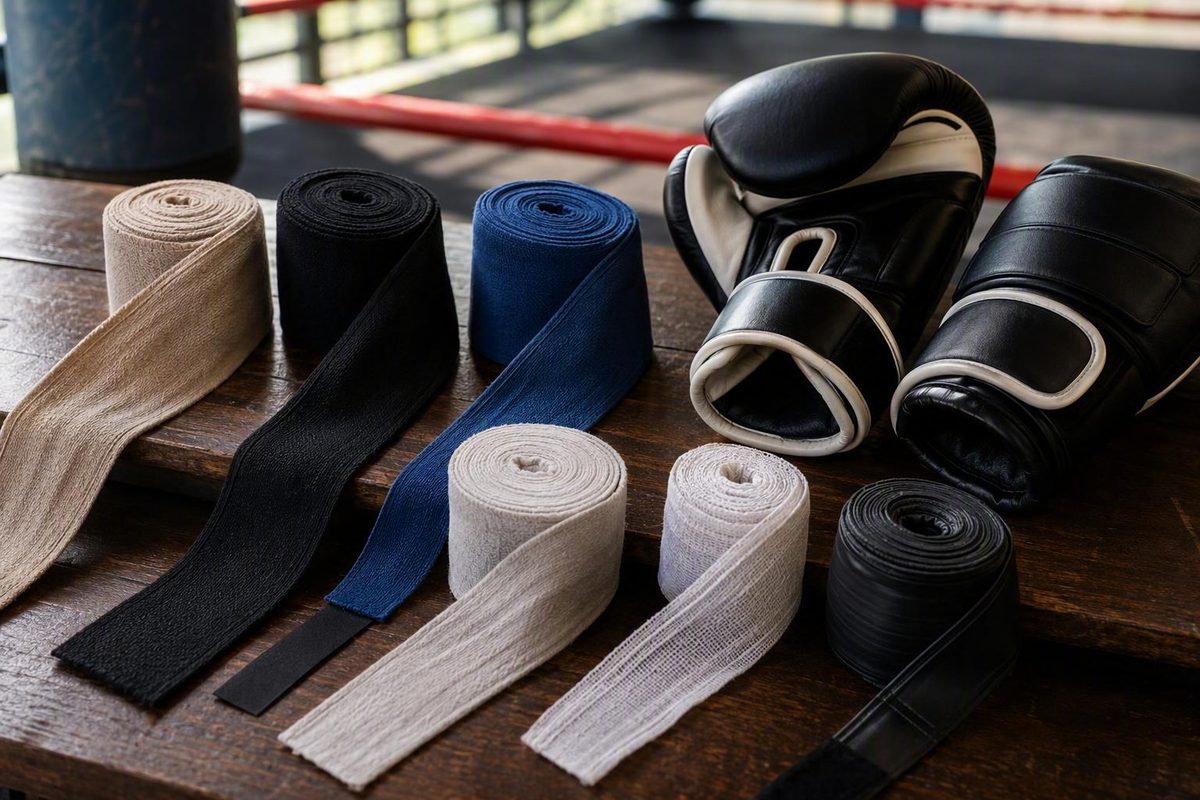
For most Muay Thai trainees, traditional reusable wraps are the best starting point when adjustable knuckle, hand and wrist coverage matters most. Consider quick or gel wraps when faster application is the priority. Whichever format you choose, the completed wrap must fit securely inside your actual gloves without loose material, bunching or excessive pressure. Competition is a separate decision: check the event’s current rules before relying on quick wraps, gel inserts, knuckle guards, gauze or tape.
The short answer: which wraps should you choose?
Use this decision guide:
- Choose traditional wraps if you want greater control over how much material covers the knuckles, hand and wrist.
- Consider quick wraps if fast application and removal matter more than customization.
- Consider gel wraps if you want built-in knuckle padding and a wrist-wrapping section, provided the extra bulk fits your gloves.
- Treat knuckle guards as supplements, not automatic equivalents to the coverage provided by a long traditional wrap.
- Check competition rules separately before buying any format for an event.
Hand wraps are commonly used to add padding around the knuckles, compress the hand, support the wrist and absorb sweat inside the gloves. These functions should not be confused with a guarantee that wraps will prevent a particular injury.
Your choice should account for five practical variables: hand size, wrapping style, desired coverage, convenience and the space available inside your gloves. A wrap may look suitable on a product page but feel too bulky or unstable once the wrapped hand is placed inside a close-fitting glove.
Competitors should ask whether their event permits traditional hook-and-loop wraps, quick wraps, gel wraps, knuckle guards or a regulated bandage-and-tape system. Equipment accepted during ordinary gym training may not pass an event inspection.
Boxing is a contact sport with real risk, and Boxing Learn’s safety guidance states that general instruction does not replace a coach or proper equipment. Ask a coach to inspect your wrapped hands and gloves, especially while you are learning to balance tension, coverage and glove fit.
Muay Thai wrap types compared
Read each product’s construction, dimensions and intended format rather than relying on the category name alone.
| Format | Application and adjustability | Padding or bulk | Reuse and practical context |
|---|---|---|---|
| Traditional stretch or semi-elastic wrap | Slower until practiced; highly customizable | Depends on the wrapping pattern and number of passes | Reusable; suited to routine training and adjustable coverage |
| Quick wrap | Faster to put on and remove; less control over material placement | Product-specific | Designed for convenience-first use |
| Gel wrap | Faster application; built-in design limits customization | Knuckle padding can add glove bulk | Intended for convenient knuckle padding plus wrist wrapping |
| Knuckle guard | Fast to position; focused on one area | Concentrated around the knuckles | Supplemental knuckle-focused product |
| Competition bandage system | Application depends on the applicable rules and supervision | Determined by permitted materials | Specialized use in regulated competition |
Traditional wraps
Traditional stretch or semi-elastic wraps let you distribute material across the knuckles, hand and wrist. This makes them adaptable, but the final result depends on how they are applied.
That adjustability helps when one person wants more wrist anchoring while another needs a lower-bulk pattern for tight gloves. It also creates opportunities for uneven tension, folds or poorly distributed material, so beginners benefit from having a coach check the completed wrap.
Quick and gel wraps
Quick wraps are slip-on or otherwise faster-application products.
Commercial collections distinguish traditional, quick, gel and knuckle-guard formats, although individual products vary considerably in construction and fit. Hayabusa’s hand-wrap collection shows these format distinctions.
The main buying question is bulk. Put the wrapped hand inside the gloves you intend to use and confirm that the glove closes normally without excessive pressure.
Knuckle guards and competition bandages
A knuckle guard concentrates material around the knuckles.
Gauze-and-tape and soft surgical-bandage systems belong in a separate category. Their permitted materials, dimensions, tape allowances and application may be controlled by competition rules. They should not be treated as ordinary gym wraps or applied according to a generic, unsourced method.
Choose length by coverage, hand size and glove space
Think of wrap length as a coverage budget. Every pass around the knuckles, wrist, thumb area or hand uses part of that budget. More material allows more passes, but it can also create unused length, folds or excessive tightness inside the glove.
A 180-inch wrap is popular because it provides enough material for multiple layers over the hands, knuckles and wrists, according to Hayabusa’s wrap-length guidance. That popularity does not establish 180 inches as the correct length for every hand, glove or wrapping style.
A 120-inch wrap is a commercially available shorter alternative. It may be worth comparing if you have smaller hands, use a lighter wrapping pattern or have limited space inside your gloves. A shorter wrap is not guaranteed to fit, however, and it must still provide the coverage and anchoring you need. Fairtex, for example, lists the same HW2 product line in 120-inch and 180-inch versions.
Four-meter wraps are another available format. Four meters is approximately 157.5 inches, making it shorter than 180 inches but longer than 120 inches. YOKKAO lists one elastic-cotton model at four meters; that specification applies to the listed product rather than every wrap sold by the brand.
| Your priority | Length to compare | Final test |
|---|---|---|
| Less material or limited glove room | 120 inches or another shorter option | Confirm the intended coverage remains secure |
| A middle-ground length | Four meters | Check for unused material, folds or glove pressure |
| More multilayer coverage | 180 inches | Confirm the glove does not become excessively tight |
| You are uncertain | At least two available lengths | Test both inside your actual gloves |
Longer is not automatically better. Compare lengths according to the coverage you want, then judge them by the completed wrap-and-glove combination rather than the number printed on the package.
Check the fit before you train
Complete this check before bag work, pad work or sparring:
- Open and close your hand. You should retain normal movement.
- Check the intended coverage. The material should remain positioned over the knuckles and around the wrist areas you intended to cover.
- Look for folds and gaps. The wrap should lie evenly rather than bunching in the palm or shifting across the knuckles.
- Put on the glove. Your wrapped hand should enter normally, and the glove should close without excessive pressure.
- Move again. Make a comfortable fist and relax it several times before training.
Excessive tightness, looseness and inadequate wrist anchoring are identified as wrapping errors in Khongsittha Muay Thai’s hand-wrap guidance.
A wrap can also be too loose. Warning signs include shifting material, bunching, gaps in the intended coverage or a wrist section that does not remain anchored. Pulling everything tighter is not an automatic solution: tension and coverage must be balanced. A loose pattern may need to be reorganized rather than simply tightened.
Beginners should have a coach inspect the completed fit and demonstrate a sequence appropriate to their hands and equipment.
Training wraps and competition bandages are not the same decision
Competition bandages are selected within a rule system. A wrap that works well in training is not automatically legal for an event.
IFMA guidance permits specified soft surgical bandaging or Velcro hand wraps, subject to applicable limits. It also states that gloves, wraps and bandages should be fitted under supervision for compliance, and that an athlete with non-compliant equipment may be excluded from participating. These provisions apply specifically to IFMA competition; athletes should consult the current IFMA competition guidance and their event organizer.
An IFMA rules document updated in March 2016 confirms that the rules included a dedicated section on bandages, with subsections for specifications and continental or world tournaments. The supplied portion does not establish substantive dimensions, materials, tape allowances or current inspection procedures. The 2016 IFMA rules document therefore should not replace the rules currently issued for your event.
Before competition:
- Identify the governing body and exact event.
- Obtain the current rules instead of relying on an old summary.
- Ask whether traditional hook-and-loop, quick, gel and knuckle-guard formats are allowed.
- Verify permitted materials, length, width and tape use.
- Ask whether an official must apply, supervise or inspect the bandaging.
- Allow enough time for the required equipment check.
- Bring a compliant alternative if the organizer recommends one.
Do not transfer IFMA requirements to professional promotions, other federations, individual gyms or local events without confirmation. Each may use different equipment rules and inspection procedures.
A practical shopping checklist
Inspect product information in this order:
- Format: traditional, quick, gel, knuckle guard or another design
- Length: stated in inches, centimeters or meters
- Material: cotton, elastic blend or another listed construction
- Stretch: rigid, semi-elastic or more elastic
- Thumb loop: present, absent or replaced by another starting system
- Closure: hook-and-loop size and placement
- Knuckle coverage: adjustable layers or built-in padding
- Wrist coverage: enough material or a dedicated wrist section
- Package quantity: one individual wrap, a pair or a two-wrap set
- Glove compatibility: acceptable fit inside the gloves you own
Do not infer package quantity from the displayed price or general product description. Confirm whether the listing includes one individual wrap or a pair. For quick or gel products, also check whether the manufacturer uses separate left- and right-hand pieces.
Marketplace results may show traditional wraps, quick wraps and inner-glove formats at widely different prices. Without a verified observation date, an exact price range would not be a reliable benchmark. Ratings, badges and recent purchase counts also do not prove construction quality, glove compatibility or protective performance.
Fairtex and YOKKAO are useful only as examples showing that 120-inch, 180-inch and four-meter products are commercially available. Their listings do not establish a brand ranking. Statements about comfort, breathability, durability, protection or support should be treated as seller claims unless supported by independent testing.
Check the exact product page before ordering. Prices, stock, colors, shipping charges, return terms, package quantities and specifications can change. Do not transfer the dimensions or construction of one model to another product from the same brand.
Wash, dry and inspect reusable wraps
Reusable wraps absorb sweat inside the gloves, so cleaning is part of basic equipment care. The appropriate frequency depends on how often and how heavily you train; the practical aim is to avoid repeatedly using damp or dirty wraps.
Retailer care guidance recommends this sequence:
- Fasten the hook-and-loop closure so it does not catch on other items.
- Place the wraps in a mesh laundry bag to reduce tangling.
- Wash them on a gentle cold cycle.
- Unroll and air dry them fully before the next session.
This sequence follows KO Studio’s published wrap-care guidance. Its warning that dryer heat may cause shrinkage or reduce stretch is retailer guidance rather than an independently tested finding, so follow the care label for your exact product.
If you train frequently, rotating multiple clean pairs can prevent you from having to reuse wraps before they are fully dry. Before each use, inspect the fabric for fraying, lost stretch, persistent bunching or a hook-and-loop closure that no longer holds. Replace the wraps when deterioration prevents a secure, even fit rather than following an arbitrary calendar interval.
The final choice has three parts: select the format according to customization versus convenience, compare lengths according to the coverage you need and the room inside your gloves, and test the completed fit for secure coverage without pressure or bunching. Competitors must make a separate rules check with their governing body or event organizer, while beginners should ask a coach to inspect how their wraps and gloves fit together.