
Choose Punching Depth or Skills Across More Fighting Ranges
Boxing concentrates on punches, footwork and stand-up defense; MMA adds kicks, clinches, takedowns, ground control and submissions. Compare gym quality too.
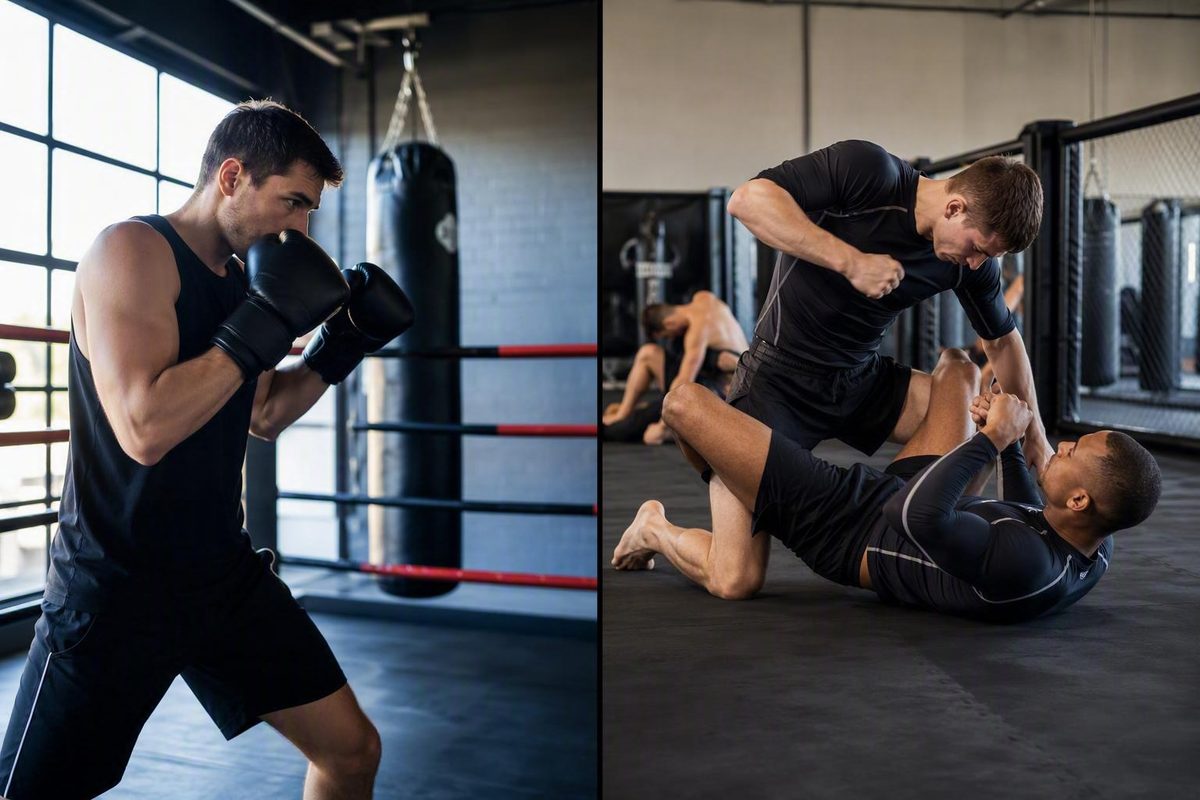
Choose boxing if you want to concentrate on punches, boxing footwork, timing, distance management, and stand-up defense. Choose MMA if you want to train striking alongside clinch work, takedowns, wrestling, ground control, and submissions. Neither is universally better. If one local gym offers clearly better coaching, partner matching, and contact control, choose the better-run program.
The short answer: boxing for specialization, MMA for breadth
The central difference in MMA training vs boxing is technical scope. Boxing gives you concentrated practice within a punching-based ruleset. MMA distributes training across striking and grappling ranges.
Broader scope does not automatically produce greater proficiency. An MMA beginner may encounter more categories of technique without developing a boxer’s depth in punching. Conversely, boxing’s narrower curriculum does not make it easy or quick to master. Specialization still requires balance, precision, timing, decision-making, and sustained practice.
| Decision point | Boxing | MMA |
|---|---|---|
| Primary goal | Develop punches and boxing movement | Combine striking and grappling |
| Technical scope | Specialized | Broad and integrated |
| Fighting ranges | Distance management, punching range, infighting, boxing clinches | Striking distance, clinch, takedowns, groundwork |
| Best fit | You enjoy refining a focused skill set | You want exposure across multiple ranges |
Boxing excludes kicks, takedowns, knees, elbows, and ground grappling, while MMA can incorporate those techniques alongside punches, according to Litesport’s comparison of boxing and MMA rules and techniques. That difference tells you what you will study, not which class will be more enjoyable, demanding, or suitable for you.
Local program quality can outweigh the sport label. If the boxing gym teaches beginners patiently while the MMA gym pressures newcomers into hard contact, choose boxing. Reverse that choice if the MMA program is structured and supportive but the boxing gym is not.
What boxing training develops
Boxing specializes in punching mechanics, combinations, stance, footwork, balance, timing, distance management, head movement, guard work, and defense under boxing rules. Its standard punch set consists of the jab, cross, hook, and uppercut, as listed in this commercial overview of boxing and MMA training.
Illustrative training methods include:
- Stance and movement drills
- Shadowboxing
- Heavy-bag work
- Mitt drills
- Combination practice
- Slips, rolls, blocks, and guard recovery
- Controlled partner drills
- Sparring when appropriate
This is not a universal class schedule. One gym may devote most of a session to footwork and the jab. Another may combine bag rounds, defensive drills, conditioning, and partner work.
Boxing Learn uses a fundamentals-first sequence: stance and footwork, followed by punches and then defense. Its syllabus names the jab, cross, hook, and uppercut, along with defensive skills such as guards, slips, and rolls.
Boxing is not merely an upper-body activity. Punching and movement depend on balance, footwork, and coordinated action through the body.
The narrower ruleset leaves more practice time for detail. A boxer can repeatedly refine how the jab manages distance, how the feet support a combination, how the head moves while balance is maintained, and how the guard recovers after a punch. That concentrated repetition is boxing’s main attraction for someone seeking depth in punching and boxing movement.
What MMA adds to the curriculum
MMA extends training beyond boxing’s punching-based rules. Depending on the gym and class, it can combine punches with kicks and other strikes, then add clinch entries, takedowns, wrestling, positional control, reversals, escapes, and submissions.
The difference becomes clearer when training is organized by range:
| Range | Boxing emphasis | MMA emphasis |
|---|---|---|
| Striking at distance | Footwork and entries into punching range | Punches, kicks, and related defenses |
| Punching range | Combinations, angles, head movement, guard work | Punches used alongside kick, clinch, and takedown options |
| Clinch | Work permitted under boxing rules | Strikes, control, trips, throws, and takedown setups |
| Takedown exchange | Not part of boxing | Entries, defense, finishes, and transitions |
| Groundwork | Not part of boxing | Control, escapes, reversals, strikes, and submissions |
The International Mixed Martial Arts Federation provides one structured example of technical development. Its progression scheme assesses striking, standing clinch and takedown work, throws, fence control, and groundwork, including attacks, defenses, and reversals. IMMAF also recommends beginning with general movement fundamentals and progressing technically before competition, as explained in its participant pathway and technical progression guidance.
That pathway does not describe every MMA gym. Some programs teach integrated MMA from the beginning. Others offer separate boxing, kickboxing, wrestling, and Brazilian jiu-jitsu classes before combining those skills. Two timetables carrying the same “MMA” label can therefore create very different beginner experiences.
The basic tradeoff is how practice time is allocated. An MMA student works across more technical areas, while a boxer can devote more attention to a narrower ruleset. That difference does not establish that either student will progress faster.
Choose according to what you want from training
There is no useful overall winner without first identifying your goal.
| Your priority | Better starting choice | Why |
|---|---|---|
| Punching mechanics and combinations | Boxing | More concentrated punching practice |
| Boxing footwork and defense | Boxing | Training is organized around boxing distance and rules |
| Striking plus grappling | MMA | Includes clinch, takedown, and ground skills |
| Eventual boxing competition | Boxing | You train for the intended rules |
| Eventual MMA competition | MMA or planned cross-training | MMA requires integration across ranges |
| General fitness | Either | Attendance, effort, class format, and enjoyment matter |
| Unsure | Trial both | Coaching and gym culture may decide the issue |
For focused striking, boxing offers more time for punching mechanics, combinations, defensive movement, and boxing-specific distance control.
For broader technical exposure, MMA provides opportunities to work across stand-up striking, clinching, takedowns, and groundwork rather than remaining within one striking ruleset.
For general fitness, the sport’s name does not determine the outcome. A demanding boxing class attended consistently may suit you better than an MMA class you dislike, and the reverse is equally possible.
For self-defense, keep the comparison bounded. MMA covers more regulated fighting ranges, including clinching and ground positions. Boxing develops specialized punching, movement, distance management, and stand-up defense.
For competition, choose the rules and permitted techniques you actually want to practise.
Can boxing be a foundation for MMA?
Yes. Boxing can provide a useful foundation for MMA, but learning boxing first is not mandatory.
A boxing-first route can develop:
- Punching mechanics and combination building
- Footwork and balance
- Timing and distance judgment
- Head movement and guard recovery
- Experience working with a standing partner
Those skills can contribute to later MMA striking, but they do not cover the full MMA curriculum. A boxer moving into MMA must still learn to account for kicks, clinch attacks, takedown entries, fence work, ground control, escapes, and submissions.
Starting directly in a well-structured beginner MMA program is equally valid. This route introduces the relationships between ranges from the beginning: strikes can lead into clinches or takedowns, clinch exchanges can move to the ground, and groundwork introduces control, escapes, reversals, and submissions.
Base the decision on your actual goal and local options:
- Start with boxing if you primarily want boxing skill, enjoy specialized striking, or have access to an excellent boxing coach.
- Start directly with MMA if MMA participation is your goal and a suitable beginner program teaches fundamentals gradually.
- Cross-train if the timetable, coaching, and your recovery allow you to study specialist disciplines without creating an unfocused schedule.
There is no fixed route that every future MMA student must follow. Coaching quality, class availability, enjoyment, and consistent attendance are more useful decision criteria.
Evaluate the gym, not just the sport
Use a trial class to assess how the program treats beginners. Ask direct questions rather than assuming “beginner-friendly” means the same thing everywhere.
Trial-class checklist:
- How does the beginner curriculum progress?
- Is technique taught before speed, resistance, or intense contact?
- When are partner drills, sparring, or live grappling introduced?
- How are partners matched by size, experience, and intended intensity?
- Is hard sparring optional?
- Can recreational students train without competing?
- What equipment is required for the trial and regular classes?
- Is the class appropriate for your age and experience?
- Who supervises beginners during partner work?
- Can you stop or reduce intensity without pressure?
Look for a coach who explains the purpose of each drill, corrects uncontrolled behavior, and introduces resistance gradually. Beginners should not have to prove commitment by accepting contact they do not understand or want.
Youth safeguards must be distinguished from adult practice. IMMAF uses modified youth competition structures and prohibits head strikes in its youth competitions. These are IMMAF-specific youth provisions, not universal rules for every gym, organization, or adult class. Parents should ask how a particular program matches youth partners, which techniques it permits, and how sessions are supervised.
Boxing Learn states that boxing is a contact sport with real risk and that written educational material does not replace a coach or proper equipment.
Do not judge safety by the words “boxing” or “MMA” alone. Instead, examine the activity being offered—technical drilling, controlled sparring, hard sparring, live grappling, or competition—and ask about contact rules, partner matching, equipment, supervision, and your ability to opt out.
Choose the program that matches your technical goal and is responsibly supervised. Take trial classes, ask how contact is introduced, confirm equipment requirements, and avoid any gym that pressures beginners into premature hard contact.
What equipment do beginners need for boxing or MMA?
Common boxing starter gear includes boxing gloves, hand wraps, and a mouthguard. MMA programs may ask for hand wraps, MMA gloves, shin guards, and a mouthguard, although requirements vary by class. These items appear in a commercial comparison of boxing and MMA starter equipment, but the list is not universal.
Ask the gym before buying anything. Confirm the required glove type and size, whether loan equipment is available for a trial, and whether technical classes, sparring, and live grappling have different equipment requirements.
Is boxing safer than MMA?
The sport label alone cannot determine whether boxing or MMA is safer. They involve different techniques and forms of contact, while the experience within either sport can vary between technical drilling, controlled partner work, hard sparring, live grappling, and competition.
Inspect the actual class rather than relying on a broad comparison. Ask whether hard sparring is optional, how partners are matched, when beginners begin contact, how uncontrolled behavior is handled, and whether you can train recreationally without competing. Choose the program with clear boundaries, gradual progression, and attentive supervision.