
Philly Shell Boxing: Learn the Guard Without Losing Your Basics
Learn the Philly shell guard, how a shoulder roll works, common beginner faults, and three solo drills before coached partner practice.
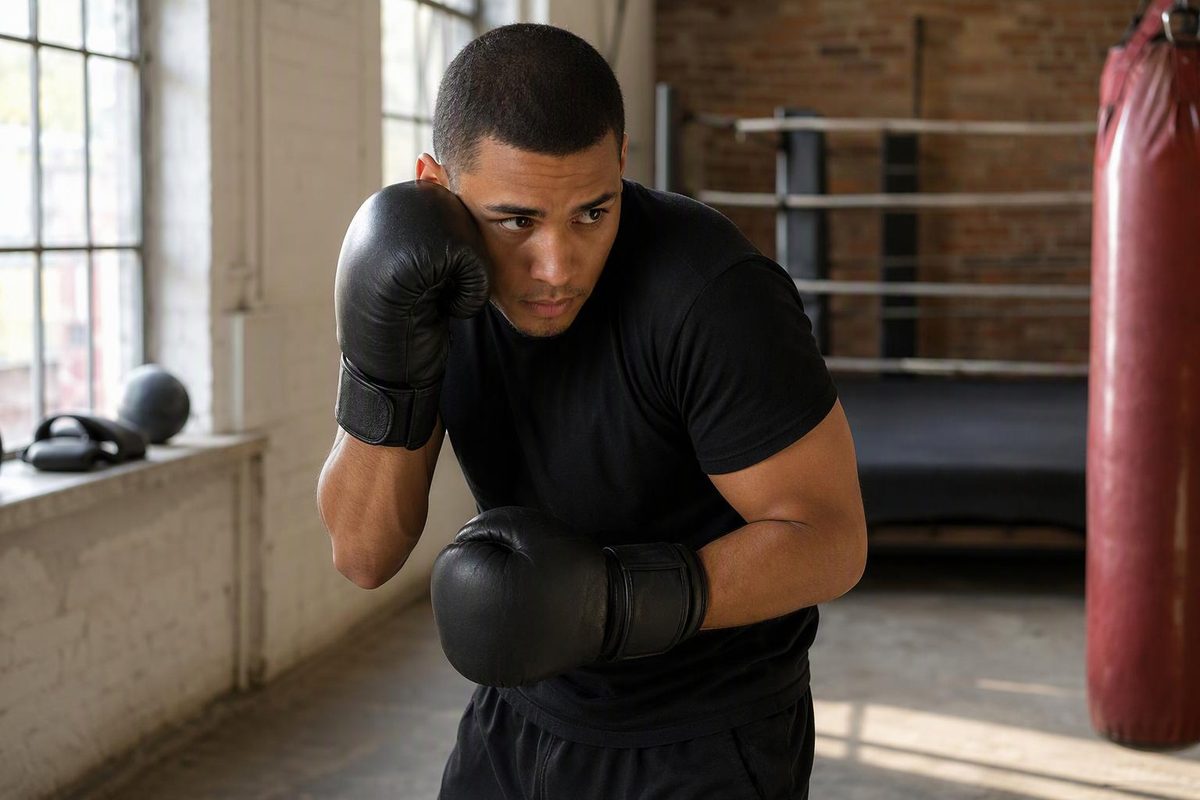
The Philly shell is a boxing guard with the lead arm held low across the body, the lead shoulder shielding the chin, and the rear glove beside the face. It combines shoulder rolls, glove defenses and counters—not just a dropped lead hand. Evolve’s technical guide describes how the lead arm protects the body while the rear glove covers the other side of the chin.
For beginners, treat it as an additional skill, not a replacement for a sound two-hand guard. First learn to punch, recover your hands and move in balance. England Boxing’s coaching handbook places stance, guard and balanced footwork at the foundation of attack and defense.
Set up the guard
The example below uses an orthodox stance: left foot and left hand forward. If those basics are unfamiliar, start with our orthodox stance guide.
- Keep your normal balanced base. Knees stay slightly bent; do not narrow your feet to look more sideways.
- Turn your torso slightly side-on. Keep your face directed toward the imagined opponent rather than turning your back.
- Lower the lead forearm across your midsection. Keep the elbow close to your ribs rather than letting the arm hang loose.
- Keep the rear glove beside your right cheek. It remains available to catch or block punches; it is not resting on your chest.
- Tuck your chin behind the lead shoulder. Keep your eyes forward and avoid forcing your neck into a tense shrug.
Checkpoint: Can you take a short step forward, backward or sideways without rearranging your feet first? If not, restore your base before working on the guard. Review beginner boxing footwork if you keep losing your stance.
The shoulder roll is an action, not the whole guard
People often use “Philly shell” and “shoulder roll” interchangeably. A useful training distinction is that the shell describes your guard arrangement; the roll is a defensive movement. You can practise a shoulder roll with your lead hand still up. ExpertBoxing’s shoulder-roll lesson explicitly demonstrates this option.
For an orthodox boxer facing another orthodox boxer’s straight right:
- Bring your left shoulder up to shield your chin.
- Turn your shoulders and hips to your right, away from the incoming punch.
- Use a small rotation rather than a large backward lean.
- Keep your right glove beside your face and your eyes on the opponent.
- Return to a balanced position, ready to defend again or counter.
The aim is to deflect the punch with the moving shoulder, not absorb it with your head. Timing matters: turning too early gives the opponent time to adjust; turning too late can leave you exposed. ExpertBoxing also cautions against leaning backward or rotating farther than necessary.
A straight right counter is one possible follow-up, but it is not automatic. Only add it when you can recover your position without reaching.
Where it can go wrong
The shoulder does not cover every punch or angle. The rear glove, body protection and footwork still have jobs to do. In an orthodox–southpaw matchup, the incoming rear hand arrives from a different side; do not simply repeat the orthodox-versus-orthodox example. FightCamp’s shoulder-roll guide highlights opposite-stance matchups as a particular difficulty and recommends mastering basic defense first.
| Common fault | Corrective drill | Checkpoint |
|---|---|---|
| Dropping the lead hand without covering the chin | Slowly alternate between your regular guard and the shell in a mirror | Chin stays tucked; rear glove stays beside the face |
| Leaning backward to avoid an imagined punch | Practise a smaller roll with both hands up | You can step immediately afterward |
| Turning so far that you lose sight of the opponent | Keep your gaze on a fixed point at eye level during slow repetitions | No exposed back or recovery shuffle |
Three short solo rounds
Use open floor space and a mirror or phone recording. These are movement rehearsals, not a test of whether you can defend real punches.
Round 1 — Guard setup, 60 seconds: Move slowly from your regular guard into the shell and back. Pause to check your chin, rear glove and lead elbow.
Round 2 — Small roll, 60 seconds: Keep both hands up. Imagine one straight right, make a small shoulder roll, then reset. Check that you can take a short step after each repetition.
Round 3 — Roll, counter, recover, 60 seconds: Continue from your two-hand guard. Roll, throw one slow straight right into empty space while keeping your lead glove up, then recover your regular guard. Stop the counter if it pulls you off balance.
Rest as needed. Before adding incoming punches, ask a qualified boxing coach to check your position and arrange controlled partner work with appropriate equipment. Do not use hard sparring to find out whether the guard works.