
How to Build a Balanced Southpaw Boxing Stance
Set up a balanced southpaw stance, move without crossing your feet, and correct common faults with simple mirror and tape-line drills.
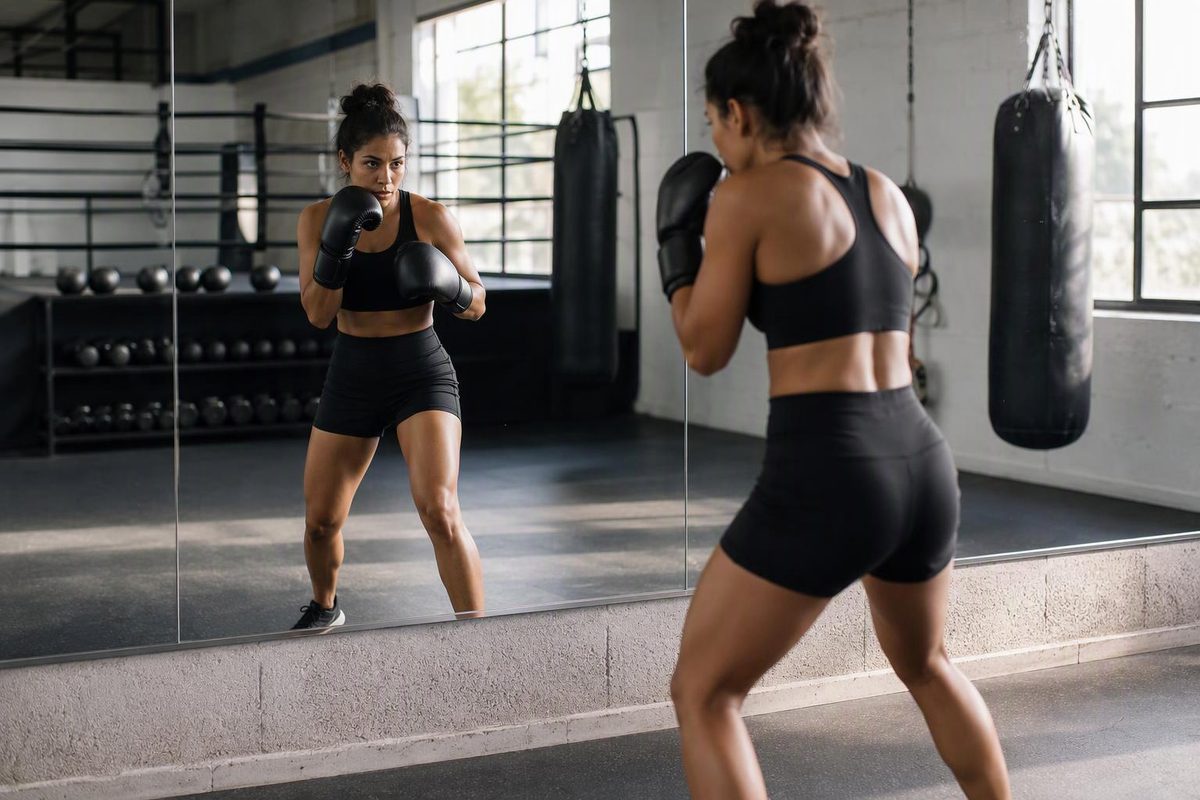
A southpaw stance puts your right foot and right hand forward, with your left foot and left hand at the rear. The right hand becomes your lead hand for the jab; the left becomes your rear hand for the cross.
That is the mirror image of an orthodox stance. It does not change the fundamentals: you still need a stable base, a compact guard and feet that can move without crossing. England Boxing describes stance as the foundation for everything else and identifies the right hand as the lead hand for a southpaw boxer in its coaching handbook.
How to set up a southpaw stance
Start without punching:
- Place your right foot in front. Keep the left foot behind and offset to the left rather than directly in line with it.
- Use a comfortable base. Set the feet a little wider than shoulder width, with enough distance front to back that you feel stable without stretching.
- Turn the feet slightly. Aim both at roughly 45 degrees to the opponent rather than straight ahead.
- Soften the knees. Do not squat, lock the legs or lean heavily over the front knee.
- Raise the rear heel slightly. Keep pressure through the ball of the left foot so you can push, turn and change direction.
- Bring up the guard. Hold the right hand slightly forward at lead-shoulder level. Keep the left hand near the left cheek, elbows close and hands closed but not tightly clenched.
- Lower the chin naturally. Look forward without forcing the chin into the chest or creating tension in the shoulders.
These details follow the stance and guard principles in the England Boxing Level 2 coaching handbook: balance, usable width and depth, an offset rear foot, a slightly raised rear heel and a relaxed guard that returns after every punch.
Checkpoint: gently rock forward and backward while keeping your base. You should feel pressure transfer through the feet without needing to take a recovery step. If the movement pulls you out of position, shorten or narrow the stance slightly.
Move the stance as one unit
Move the foot closest to the direction of travel first:
- Forward: right foot, then left.
- Backward: left foot, then right.
- Right: right foot, then left.
- Left: left foot, then right.
Use short sliding steps. The second foot restores the original width and depth; it should not meet or pass the first foot. England Boxing’s footwork guidance emphasizes maintaining the base, avoiding crossed feet and using smooth steps with minimal bounce.
Do not reach for punching range by leaning over the right leg. Move the feet until the target is in range, punch from a balanced base and recover to the same stance.
Add the southpaw jab and cross
Your southpaw jab is a straight right hand. From guard:
- Drive lightly from the floor and rotate the hips a small amount.
- Send the right glove directly toward the target without drawing it back first.
- Keep the left glove beside the cheek.
- Let the right shoulder help shelter the chin.
- Return the right hand along the same line.
The rear straight is the left cross. Turn the rear foot slightly, rotate the left hip and shoulder, and send the glove straight—not around the side. Keep the right hand home while the left is travelling, maintain contact between the rear foot and floor, then return to guard.
If either punch makes your feet narrow, your head tip over the lead knee or your rear foot swing into line, reduce the speed. Build the lead hand first with The Jab, Built From Stance Up, then add the left cross.
Three common southpaw faults
Feet in one line
When viewed from the front, the left foot disappears behind the right. This reduces side-to-side stability and can leave you poorly placed to move after punching.
Fix — rail drill: place two parallel strips of tape on the floor. Keep the right foot on one rail and the left on the other while stepping in four directions. Freeze after each step and check that the stance still has width.
Rear heel rooted to the floor
A flat left heel can hinder fluent movement.
Fix — step and settle: take one short step in any direction, pause and check that the rear heel is light rather than forced high. Repeat slowly for one-minute rounds.
Reaching with the jab
The right foot stays behind while the chest falls over the lead knee. The punch may reach farther, but the stance can no longer support a clean recovery or defence.
Fix — jab and freeze: throw a single right jab at low speed, then stop at full extension. You should still be able to bring the glove back and step in any direction without first pulling your body upright.
A 10-minute southpaw practice
Use this as solo technique work:
- 2 minutes: hold the stance in front of a mirror; relax the shoulders and check foot offset.
- 3 minutes: step forward, back, right and left without punching.
- 2 minutes: throw single right jabs, freezing occasionally to inspect balance.
- 2 minutes: throw the right jab–left cross, returning both hands to guard.
- 1 minute: move freely and reset as soon as the stance becomes too wide, narrow or square.
Work slowly enough to see each error. The goal is not fatigue; it is to finish every movement able to punch, defend or change direction. Practise contact drills, partner work and sparring only under a qualified coach with appropriate equipment and clear intensity rules.