
Weight Exercises for Boxing: Four Lifts to Start With
Learn four beginner weight exercises for boxing, with technique checks, a twice-weekly workout and simple progression that keeps boxing practice first.
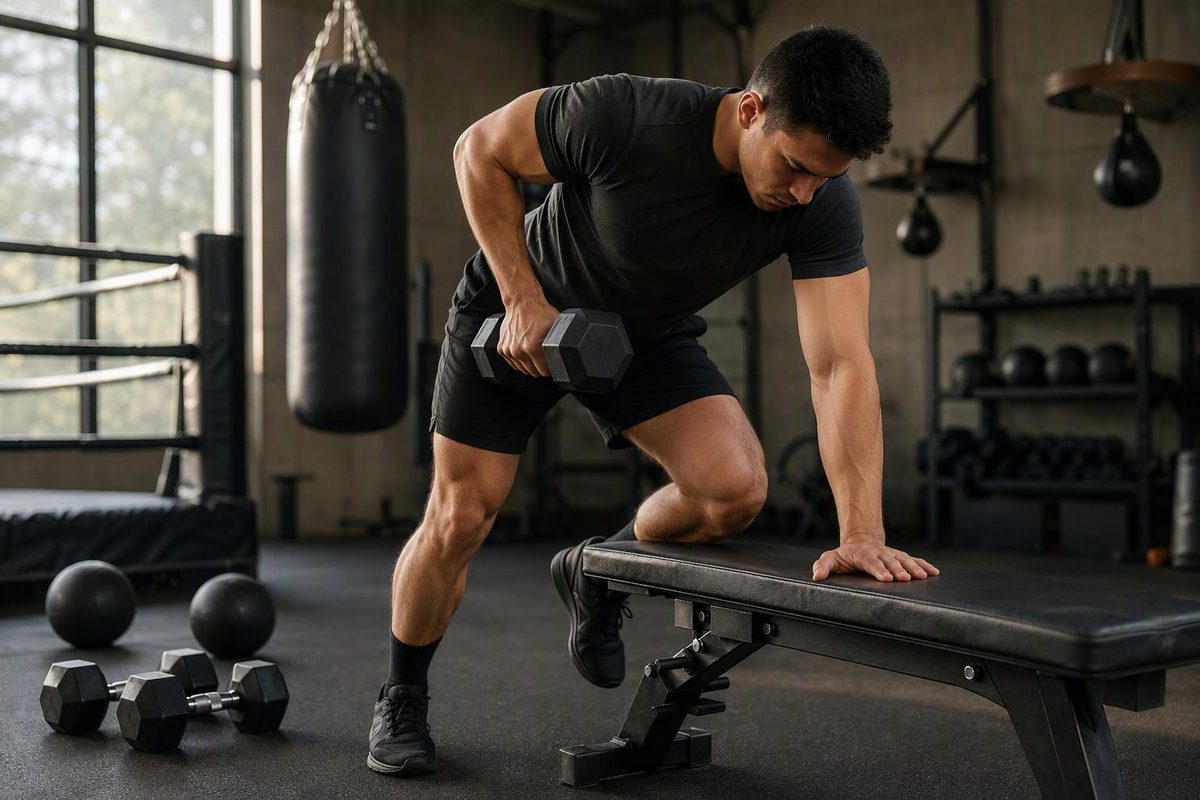
Start with four weight exercises for boxing: a goblet squat, dumbbell Romanian deadlift, supported dumbbell row and dumbbell floor press. Together, they cover squatting, hinging, pulling and pushing without requiring advanced barbell lifts.
Use them to build general strength alongside boxing—not to replace stance, footwork or punching practice. Boxing Science starts its foundational strength work with basic, lightly loaded movements, including goblet squats and kettlebell Romanian deadlifts, before progressing to heavier training. Its coaching guidance emphasizes movement quality before load.
Four exercises and their technique checks
You need dumbbells, a clear floor area and a stable exercise bench for the row. Choose the weight separately for each exercise; one pair may not suit every movement. If lifting is new to you, have a qualified trainer check your setup before adding weight.
1. Goblet squat
Purpose: Strength work for the legs and hips.
Setup: Stand with your feet roughly shoulder-width apart, toes turned slightly out. Hold one dumbbell securely at chest height, close to your body.
Action: Brace your trunk, then bend your knees and hips to sit down between your feet. Keep your whole foot on the floor and let your knees follow the direction of your toes. Descend only as far as you can control without rounding your lower back, then stand without rocking forward. NASM’s goblet-squat guide likewise prioritizes bracing and controlled depth.
Checkpoint: Your heels stay down, and the weight remains close to your chest.
Common fault → correction: If your heels lift, reduce the depth and practise five unweighted squats before trying the dumbbell again. Do not force a deeper squat by tipping forward.
2. Dumbbell Romanian deadlift
Purpose: Strength work for the back of the legs and hips. “Romanian deadlift,” often shortened to RDL, describes a hip-hinge movement rather than a squat.
Setup: Stand with a dumbbell in each hand, arms hanging in front of your thighs. Soften your knees.
Action: Push your hips backward while keeping the weights close to your legs. Keep your back position steady. Stop when you feel tension in your hamstrings or before your back starts rounding, then bring your hips forward to stand tall. Do not lean backward at the finish.
Checkpoint: Your hips move backward more than your knees move forward; the dumbbells do not need to reach the floor. Coach William Wayland’s RDL guidance likewise prioritizes a close weight path and a depth you can maintain without changing spinal position.
Common fault → correction: If it becomes a squat, put the weights down. Stand a short step in front of a wall, facing away, and practise sending your hips back to touch it.
3. Supported one-arm dumbbell row
Purpose: A pulling exercise for the back and arms, alongside your pressing work.
Setup: Place one hand on a stable bench. Step your feet apart, hinge forward and hold a dumbbell in your free hand beneath your shoulder. Keep your torso steady.
Action: Pull your elbow toward your hip, then lower the dumbbell under control. Complete the repetitions before changing sides. Catalyst Athletics’ row guide describes bench support and allows an arm-only support variation.
Checkpoint: Your shoulders stay roughly level; your chest does not turn upward to finish the pull.
Common fault → correction: If you twist or jerk the weight, use a lighter dumbbell and pause briefly at the top. Keep the same controlled pace on both sides.
4. Dumbbell floor press
Purpose: A pressing exercise for the chest, shoulders and triceps—not a weighted imitation of a punch.
Setup: Lie on your back with knees bent and feet flat. Use light dumbbells you can position and put down safely. Hold them above your shoulders with wrists straight.
Action: Lower until your upper arms gently touch the floor, then press upward. Keep your elbows slightly away from your ribs rather than flared straight out. The basic movement is described in this floor-press guide.
Checkpoint: Both weights rise evenly without your lower back arching to help.
Common fault → correction: If one arm lags or your elbows hit the floor, reduce the load and slow the lowering phase.
A twice-weekly starting workout
Use this as a starting template for a healthy adult beginner, not a fight-camp prescription:
| Exercise | Sets | Repetitions |
|---|---|---|
| Goblet squat | 2 | 8–12 |
| Dumbbell Romanian deadlift | 2 | 8–12 |
| Supported dumbbell row | 2 | 8–12 per side |
| Dumbbell floor press | 2 | 8–12 |
- Warm up for 5–10 minutes: easy walking or marching, then unloaded squats, hinges and light practice repetitions.
- Rest about 90 seconds between sets, longer if you cannot repeat the movement cleanly. Finish one exercise before moving on; this is strength practice, not a timed circuit.
- Leave at least two good repetitions in reserve: end the set while you could still perform two more with the same technique.
- Leave at least one day between lifting sessions. For your first few sessions, one set per exercise is enough to learn the movements and check recovery.
These choices sit within NASM’s beginner programming guidance. ACSM’s 2026 resistance-training update also emphasizes regular participation and notes that training to muscle failure is not necessary for the average healthy adult.
Progress without crowding out boxing
Begin near eight repetitions. Add repetitions as control improves. Once you can perform both sets of 12 cleanly, with two repetitions still available, increase the weight by the smallest practical amount and return toward eight. Change one thing at a time.
Keep punching practice unweighted in this beginner plan. Use solo boxing drills to work on guard recovery, balance and footwork rather than trying to learn those skills while holding dumbbells.
Schedule lifting away from demanding boxing sessions where possible. If your legs are too sore to move normally or your shoulders feel heavy during technique practice, reduce the lifting volume before adding more. Stop an exercise that causes pain; persistent symptoms or an existing injury need individual advice. If you spar, coordinate the lifting schedule with your coach rather than treating this template as preparation for contact.