
What Is Shadow Boxing? How to Practise It With Purpose
Shadow boxing is solo boxing practice without a target. Learn what it trains, how to structure three beginner rounds, and which faults to avoid.
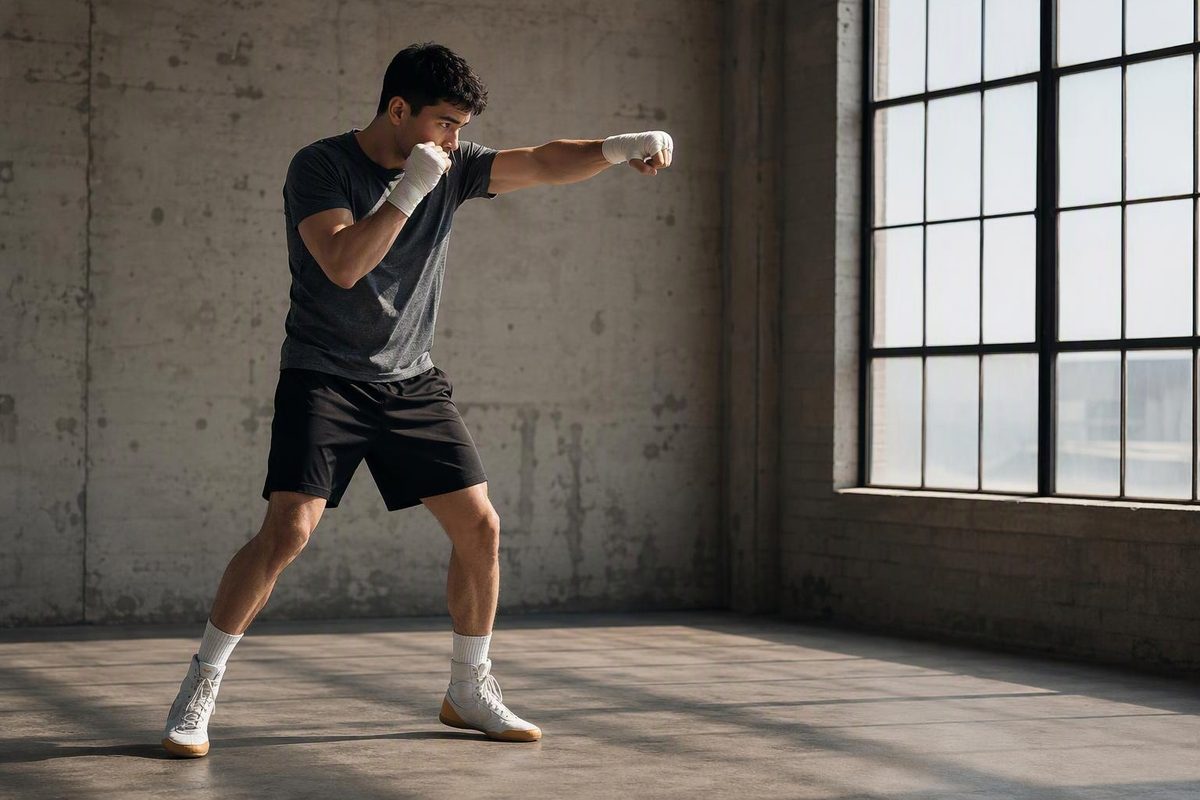
Shadow boxing is solo boxing practice in which you move, punch and defend against an imagined opponent. There is no bag, pad holder or sparring partner. The aim is not merely to throw punches into the air; it is to rehearse complete boxing actions while keeping your stance, guard, balance and position.
That makes shadow boxing useful for rehearsing technique, warming up and working through tactical situations without contact. Boxing Canada’s beginner reference material lists stationary shadow boxing, shadow boxing with short steps and a version in which boxers follow a group leader. It also describes a mirror as a way to check stance, hand position and technique (Boxing Canada beginner reference manual). England Boxing likewise includes shadow boxing among the technical skills in its coaching framework (England Boxing coaching handbook).
What does shadow boxing train?
A purposeful round can help you practise:
- Stance and balance: staying ready to punch, defend or move in any direction.
- Footwork: stepping without bringing the feet together or crossing them.
- Punch mechanics: sending punches from the guard and returning each hand promptly.
- Defense: adding slips, rolls, blocks, parries and exits after attacks.
- Combinations: connecting punches without pausing between them.
- Positioning: imagining where an opponent is and adjusting distance or angle.
- Rhythm and conditioning: changing pace while continuing to move with control.
Shadow boxing provides no impact or resistance, so it cannot show how a punch feels when it meets a target. Bag work provides target feedback; partner drills and coached sparring add timing and reactions. Shadow boxing complements those activities rather than replacing them.
How to shadow box
Use a clear, non-slip floor with enough room to take several short steps in every direction. A mirror can help you check posture, but it is optional. Gloves and hand wraps are not normally needed because you are not striking anything.
- Take your stance. Keep the knees soft, chin down, hands up and weight balanced. If the stance is unfamiliar, start with this beginner footwork guide.
- Picture an opponent. Give that opponent a head, body and reach. Look toward them rather than at the floor or your own fists.
- Move into range. Use short, controlled steps. Let the other foot follow so your stance does not become too narrow or too wide.
- Punch with technique, not maximum force. Begin with the jab and straight rear hand. Exhale briefly, rotate as your coach has taught you and bring each hand back to guard.
- Expect a reply. After a punch or combination, defend or change position. For example: jab, slip, step out; or jab–cross, roll, pivot.
- Reset in stance. Check that your feet are under you and your guard is back before beginning the next exchange.
Keep the first sessions slow. Add speed only while you can preserve the same balance and shape.
A simple three-round beginner drill
A practical starting format is three two-minute rounds with 45–60 seconds of rest. This is a drill structure, not a required round length. Shorten a round if your technique starts to deteriorate.
Round 1: Stance and feet
Move forward, backward, left and right without punching. Every few steps, stop and check your position: knees soft, feet separated, hands up and head between the feet.
Round 2: Straight punches
Add single jabs, then jab–cross combinations. Step only when needed to reach the imagined target. For a detailed setup and return, see how to build the jab from your stance.
Checkpoint: After every punch, can you move immediately without first recovering your balance?
Round 3: Attack, defend, exit
Repeat one simple sequence:
- Step in with a jab.
- Throw the rear straight.
- Slip an imagined counter.
- Step out at an angle.
Picture the opponent throughout the round. This turns a memorised combination into a basic exchange with a reason for every action.
The common fault: throwing random punches
Beginners often shadow box by firing long, fast combinations while their feet remain still and their guard drops. The movement may feel busy, but it rehearses poor habits.
Fix it with one theme per round. Try “step with the jab,” “hands return to guard” or “defend after every combination.” Work slowly enough to observe that theme. If the stance breaks, reset rather than punching through the mistake.
Good shadow boxing should look like controlled boxing without contact: a stable stance, economical steps, clear targets and a defensive response. When those features disappear, reduce the speed and simplify the task.