
How to Choose and Use Bands Without Letting Resistance Rewrite Your Boxing
Distinguishes footwork, rotation, shoulder and punching setups, then explains technique tradeoffs and why speed or power gains remain unproven.
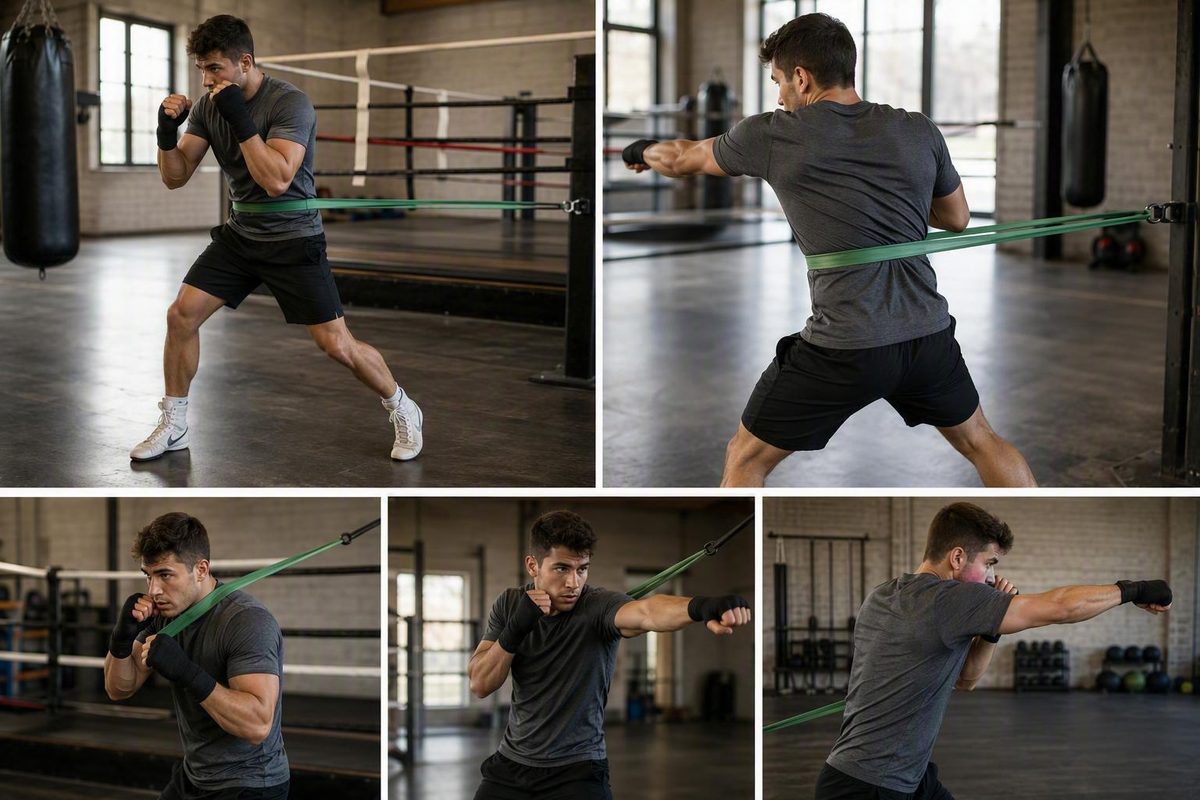
Boxing resistance bands are easy to buy and easy to misunderstand. One setup resists the hands as they travel forward from behind the boxer. Another tethers the wrists to a fixed point. A small loop challenges stance and stepping, while a belt-and-cuff system loads several limbs at once. Although all may be sold under the same broad label, they do not create the same exercise or solve the same training problem.
Bands can provide portable resistance for footwork, rotation, shoulder conditioning and selected punching drills. They can also make a punch look and feel different from an ordinary punch. That distinction matters because the evidence reviewed for this guide does not establish lasting improvements in unresisted punch speed, power, accuracy, explosiveness, endurance or competitive performance.
The reviewed material consists mainly of seller-listed product details, commercial training guides, social-media promotion and coaching opinions. It includes no controlled study establishing performance transfer. Product specifications are therefore described as manufacturer- or seller-listed rather than independently verified, and safety recommendations should be treated as conservative precautions rather than guarantees.
A sensible approach is goal-first and technique-first:
- Decide whether you want to train stance, footwork, rotation, shoulders, punching or whole-body movement.
- Choose a configuration that applies resistance in a useful direction.
- Start with the lightest tension that preserves normal mechanics.
- Keep resisted intervals short.
- Audit the result with ordinary, unresisted boxing.
- Treat bands as supplementary equipment—not a replacement for coaching, bag work, sparring or broader strength and conditioning.
What Counts as a Boxing Resistance Band?
It can include anything from a basic loop to a wearable system with a belt, cuffs, clips, gloves and separate bands for the arms and legs.
The main configurations are:
- Behind-the-back punch bands: A continuous band or two handles pass behind the torso and resist the hands as they travel forward.
- Fixed-anchor bands: Tubing is secured behind, beside, above or below the boxer to load presses, pulls, rotations, punches or movement.
- Above-knee loops: A small loop sits above the knees and resists stance width, lateral steps, pivots and level changes.
- Ankle-level loops or attachments: Resistance acts closer to the feet, increasing the demand on foot separation and clean stepping.
- Under-foot bands: The boxer stands on the band and holds its ends, creating an upward or diagonal pull as the arms move.
- Belt-and-cuff systems: Bands connect a waist belt to wrist, hand or ankle attachments.
- Shoulder-conditioning bands: Light tubing or loops are used for controlled rows and internal or external shoulder rotations rather than punching.
- Full-body wearable systems: Multiple attachments resist the arms and legs simultaneously.
These configurations are not interchangeable. A loop above the knees principally challenges lateral leg separation. An anchor behind the boxer creates a rearward pull that increases as the hands advance. A side anchor can load a pulling or rotational exercise. A full-body harness adds multiple force directions, along with more components to fit, inspect and manage.
The retail category is similarly broad. TITLE Boxing’s resistance-training range groups products under shadowboxing, stance, footwork, hand-speed and related training labels. That shows how the seller categorizes its equipment; it does not demonstrate that every listed product produces every promoted outcome.
An Amazon search for boxing resistance bands displayed more than 1,000 results in the captured page, including basic punch bands and sets with ankle cuffs. Search position, sponsored placement, ratings, badges and purchase counts can change and are not evidence that a product improves boxing performance or is durable.
Some products are better described as general combat-sports resistance equipment. The Stroops Striker, for example, is marketed primarily for MMA and kickboxing punch-and-kick training. Its hand attachments may still be relevant to boxing, but that does not make the entire system boxing-specific.
Portability is a genuine practical distinction. Bands are compact enough for a home, gym bag or trip. Yet portable equipment is not automatically effective or suitable. It still requires adequate space, an appropriate resistance level, a secure setup where anchoring is involved and a drill connected to a defined purpose.
Match the Band Setup to the Training Goal
There is no overall “best boxing resistance band.” The more useful question is: What are you trying to train, and can the setup add resistance without corrupting the movement you care about?
| Goal | Configuration | Loading pattern | Setup needs | Principal technique concern | Best role in a broader boxing program |
|---|---|---|---|---|---|
| Stance and lateral footwork | Light loop above knees | Pulls inward as stance widens | Clear floor and correctly sized loop | Knees collapsing inward or stance becoming unnaturally wide | Short movement intervals followed by normal footwork |
| Foot placement | Ankle-level loop or cuffs | Resists separation closer to the feet | Clear floor and secure attachments | Shuffling, crossing feet, shortened steps or loss of balance | Controlled stepping rather than maximum-speed movement |
| Rotation and core work | Securely anchored band | Sideways or diagonal pull | Suitable anchor and clear working area | Turning a strength exercise into an imprecise imitation punch | Separate strength work performed under control |
| Shoulder preparation | Light single band | Internal or external rotational resistance | Stable position and comfortable range | Excessive load or treating conditioning as rehabilitation | Optional preparation before ordinary boxing |
| Straight-punch resistance | Behind-the-back band | Resistance rises through extension | Suitable band length and secure grip | Shortened extension, altered shoulder position and assisted return | Brief conditioning drill with an immediate technique audit |
| Punching from a fixed point | Rear anchor | Increasing rearward pull as the hand advances | Secure anchor and clear recoil area | Leaning, overreaching or delayed balance recovery | Carefully controlled drill, preferably observed by a coach |
| Punching with vertical loading | Under-foot band | Upward or diagonal resistance | Secure footing and even band lengths | Raised shoulders, changed guard or movement underfoot | General arm and shoulder conditioning |
| Mobile resisted punching | Belt-mounted hand bands | Resistance follows the waist | Correct belt fit, cuffs and compatible gloves | Asymmetry, friction or attachment movement | Drill variety where mobility is specifically useful |
| Simultaneous arms and legs | Belt-and-cuff system | Multiple limb tethers | Belt sizing, cuffs, clips and several bands | Complexity and competing directions of pull | Broader combat-sports conditioning when the attachments solve a defined need |
Stance and footwork
For stance work, a light loop above the knees is the simplest option. The purpose is not to force the widest possible stance or exhaust the hips. It is to maintain your ordinary stance width while managing a modest inward pull.
Watch four things:
- Keep the knees aligned rather than allowing them to collapse inward.
- Let the feet land cleanly instead of scraping, crossing or hopping.
- Do not widen the stance simply to keep the loop taut.
- Remain balanced enough to punch, defend or change direction.
Moving the loop to ankle level changes the task. It may also make ordinary movement deteriorate sooner, so reduce the tension or simplify the pattern as needed.
A Vali Sports commercial guide describes both above-knee and ankle-level variations and suggests timed movement drills with light bands. These are retailer examples, not validated prescriptions for every boxer. Its instructions also include modifications that this guide does not recommend, such as cutting a loop or tightly wrapping a band around the hands. Treat the guide as an example of commercial programming, not a safety standard.
Rotation and core work
An anchored band can be useful for controlled pulls, anti-rotation holds or rotational exercises. It does not have to become a resisted hook.
Separating the exercises often makes the purpose clearer:
- Perform the rotational strength movement deliberately.
- Reset your stance.
- Practice the hook, cross, pivot or defensive rotation without resistance.
Anchor height and position change the direction of pull, so choose them according to the exercise rather than because a setup merely looks like a punch.
Shoulder preparation
Internal and external shoulder rotations are different from resisted punching. They use smaller, controlled movements and should feel like preparation or conditioning—not an attempt to throw fast punches against load.
A NUBOXX commercial guide recommends three sets of 15 internal and external rotations per arm. That is general, non-individualized advice from a commercial source. It does not establish an optimal dose, guarantee injury prevention, treat pain or replace professional assessment.
Use a light band, control both directions and stay within a comfortable range. If your shoulder already hurts, do not treat a generic warm-up exercise as rehabilitation.
Punching configurations
Punch-focused setups differ substantially:
- Behind the back: Portable and simple, but resistance generally rises as the fist extends. Depending on placement, the band may contact the arms or pull the shoulders into an unwanted position.
- Fixed behind the boxer: Creates a clear rearward pull but restricts movement and introduces an anchor that must be inspected and managed. Anchor distance also affects starting tension.
- Under the feet: Avoids a wall anchor but adds vertical resistance. It may encourage elevated shoulders or change the guard, and the band must remain stable underfoot.
- Belt mounted: Permits more movement because resistance originates near the torso. The tradeoff is additional hardware, fit variables and attachment points.
- Hand-and-ankle wearable: Loads several limbs at once but can make it difficult to identify why movement is changing. More resistance directions do not automatically make a drill more boxing-specific.
Choose among these options according to the task and your ability to retain ordinary stance, balance, punch path, extension, relaxation and active return to guard. If those qualities disappear, the resistance is too demanding or the configuration is wrong for that skill.
Do Boxing Resistance Bands Improve Speed or Power?
The straightforward answer is: the evidence reviewed for this guide does not establish that boxing resistance bands create lasting improvements in unresisted punch speed or punching power. Nor does it establish lasting improvements in accuracy, explosiveness, endurance or competitive performance.
That does not mean bands are useless. It means the evidence supports a narrower buying proposition than much of the marketing.
1. Seller-listed product specifications
Specifications can answer practical questions:
- How long are the bands?
- What resistance options does the seller list?
- What components are included?
- Does the system require an anchor?
- What belt sizes are offered?
- Is a stretch limit stated?
These details can help assess fit and setup. Unless independently tested, however, they remain manufacturer- or seller-listed specifications rather than verified performance characteristics.
2. Manufacturer and retailer claims
Sellers commonly associate bands with speed, power, endurance, mobility, technique or explosiveness. Commercial drill guides may also prescribe particular rounds and exercises. Such material shows how a product is promoted or intended to be used; it does not establish that the claimed transfer occurs.
For example, KO Studio promotes band-resisted shadowboxing for several punching qualities and recommends short beginner rounds. The page does not provide controlled comparisons or objective outcome measurements. Its programming is commercial guidance, not proof that the method improves unresisted boxing performance.
3. Coaching opinions
Coaches disagree. Some use resisted shadowboxing for conditioning or variety. Others argue that elastic resistance changes the force direction, assists the hand’s return or converts a precise sport skill into a related but different exercise.
These arguments may be mechanically plausible and useful in practice, but the coaching sources reviewed here do not supply controlled outcome data. They should be treated as training judgments rather than settled findings.
4. Unresolved research questions
Important questions remain unanswered in the reviewed material:
- What tension adds useful overload without materially changing punch mechanics?
- Does any improvement remain after the band is removed?
- Do beginners and experienced boxers respond differently?
- How should fast band punches compare with slow, controlled resistance exercises?
- Does assisted retraction create persistent changes in guard recovery?
- What volume and frequency are tolerable over several weeks?
Commercial guides and social-media creators promote bands for punches, conditioning, speed, endurance and technique, but that promotional coverage does not resolve these questions. One example is a Tony Jeffries social-media post promoting resistance-band shadowboxing; it is promotional content, not controlled research.
A boxer may feel unusually quick immediately after removing resistance. That subjective contrast does not prove a durable adaptation. Demonstrating lasting improvement would require repeatable unresisted measurements after the immediate sensation had passed, ideally with a suitable comparison.
Beginners may still receive general shoulder or conditioning work from an appropriately challenging exercise. Even then, “I became better conditioned” is not the same claim as “the bands made my unresisted punches faster.”
Practical verdict: buy bands for a defined resistance exercise, compact storage, travel or drill variety—not on a guaranteed promise of faster or harder punches.
The Technique Debate: Loading Extension and Assisting Return
A conventional punch band becomes harder to stretch as the fist moves away from the body. It therefore increasingly resists extension. When the boxer brings the hand back, the stretched band pulls in the same general direction as the returning hand.
This creates the central criticism: the band may resist the outward phase but assist the inward phase, while an ordinary punch requires the boxer to recover the hand actively and deliberately to guard.
In an ExpertBoxing video opposing elastic-band punching, the presenter argues that this loading pattern does not address the active retraction he considers important. He does not call every use of bands useless, and the video presents no controlled comparison showing that band work causes lasting technical harm.
A second objection concerns specificity. If an unresisted punch is a precise coordination task, adding load may create a sufficiently different movement that the boxer is practicing another exercise rather than strengthening the original skill. Strength Zone Training presents this coaching argument, favoring separate sport-skill practice and resistance exercises intended to develop transferable force patterns.
Again, this is a training position, not proof that resisted shadowboxing necessarily damages technique. Its practical value is that it directs attention to observable changes.
Check whether resistance alters:
- Stance: Do the feet narrow, widen or turn?
- Balance: Do you lean toward the punch or struggle to recover?
- Punch path: Does a straight punch become arcing or downward?
- Shoulder position: Do the shoulders rise or roll forward excessively?
- Elbow alignment: Does the elbow flare or lock abruptly?
- Relaxation: Do you remain loose, or does the movement become strained?
- Extension: Do punches stop short because the final portion is too difficult?
- Timing: Do the feet, hips, torso and hand stop arriving together?
- Guard recovery: Does the hand return mainly because the elastic pulls it back?
- Defense: Can you still cover, slip, move and reset without organizing everything around the band?
Use an unresisted audit
A simple audit is more useful than debating the equipment in the abstract:
- Perform a brief round of ordinary shadowboxing.
- Note your stance, rhythm, extension, breathing and return to guard.
- Use the band for a short, simple interval.
- Remove it immediately.
- Repeat the same unresisted work.
- Compare the rounds, ideally using a mirror or video.
If you are reaching, flaring the elbows, shortening punches, losing balance, delaying the guard or carrying excess tension into ordinary shadowboxing, reduce the resistance or stop resisted punching.
This approach fits a fundamentals-first sequence. Boxing Learn organizes its syllabus around stance and footwork before punches and defense. External resistance should not outrank the base skill it is intended to support.
Boxing is a contact sport with real risk, and written guidance cannot inspect your equipment or evaluate your movement in real time. Boxing Learn explicitly states that its material does not replace a coach and proper equipment.
How to Choose a Band or Wearable System
Ignore the front-of-box promise for a moment. A useful product page should provide enough information to assess resistance, fit, movement, setup, inspection and replacement. Many listings do not.
Buyer checklist
Before buying, look for:
- Resistance rating: Is tension stated, and does the seller explain how it was measured?
- Starting length: How long is the band before stretching?
- Stretch limit: Does the manufacturer state a maximum extension ratio or distance?
- Material: Is the tubing latex, non-latex, layered, fabric-covered or unspecified?
- Protective sleeve: Is the tubing enclosed, and what purpose does the manufacturer claim for the sleeve?
- Anchor requirements: Is an anchor included, and is it intended for a door, rack, post, wall or belt?
- Cuffs and handles: Are they adjustable, padded, replaceable and intended for wrists or ankles?
- Clips and connectors: What secures the band, and where will the hardware sit during movement?
- Belt sizing: What waist range does each size fit?
- Ankle attachments: Are they included or sold separately?
- Glove compatibility: Can the hand attachment fit inside a boxing glove without changing wrist position?
- Included components: Count the bands, cuffs, clips, anchors, handles, belt, bag and instructions.
- Replacement guidance: Does the manufacturer specify inspection or replacement intervals?
- Warranty and returns: What is covered, for how long and under what conditions?
“Light” from one company may not match “light” from another.
Use a form-based selection rule: choose the lightest tension that lets you maintain normal stance, balance, punch path, comfortable extension, breathing, relaxation and deliberate guard recovery. This is not a universal resistance prescription. It is a practical way to reject a load that is already changing the task.
A specification-rich example
The Stroops Striker product page lists two 12-inch and two 14-inch sleeved bands, nominal 20- and 25-pound options, medium and large belts and low-profile punch gloves described as fitting inside boxing gloves. The manufacturer also states a four-to-one stretch capacity.
Those details help buyers ask concrete questions about fit, length, attachments and operating range. They do not prove that the system improves boxing performance, and the figures have not been independently verified here. Because the product is marketed primarily for MMA and kickboxing, boxing buyers should also consider whether its ankle and kicking-oriented capabilities solve a problem they actually have.
By contrast, TITLE’s category illustrates the breadth of the market, but many captured listings omit resistance ratings, materials, dimensions or complete component details. Ask for missing specifications rather than assuming a product is safe, durable or boxing-specific.
Basic bands versus full-body systems
The captured seller pages displayed basic band products at roughly $10–$20, while the Striker wearable system was listed at $152.95. These are historical captured figures rather than verified current prices: the basic examples appeared in TITLE’s captured product range, while the Striker listing also showed unclear availability. Recheck current price, stock, included components, sizing, shipping, returns and warranty terms before purchasing.
A higher price may buy:
- More attachments
- Greater specification detail
- A belt and cuffs
- Sleeved tubing
- Multiple resistance options
- More movement freedom than a fixed wall anchor
It does not automatically buy better boxing results.
A basic loop may be sufficient for stance work. A single anchored band may cover rows and rotations. A wearable system makes sense only when its mobility or simultaneous limb attachments address a defined training need. Otherwise, the additional parts mean additional cost, setup and inspection.
Safety Checklist Before Every Session
Anchored and high-speed drills therefore require deliberate setup, equipment inspection and control. The following are conservative precautions; they cannot eliminate risk.
Before every session:
- Inspect the full band or loop for cuts, nicks, cracks, thinning, deformation, discoloration or sticky areas.
- Check fabric sleeves for abrasion, torn stitching or exposed tubing.
- Examine handles, seams, cuffs, closures, clips and connectors.
- Confirm that a belt or cuff does not slide under light test tension.
- Inspect the anchor and the object supporting it.
- Remove visibly damaged equipment from use instead of testing it at speed.
KO Studio’s commercial guide likewise advises users to inspect bands for wear, warm up, maintain balance and form and progress gradually. It also warns that excessive resistance or volume may contribute to fatigue, strain or technique deterioration. Those recommendations are general commercial guidance rather than a validated safety protocol.
For anchored work, use an anchor intended for the expected direction of pull. Keep your face, other people, pets, fragile objects and walkways outside the likely recoil path, and begin with a slow test pull before adding speed. These are conservative precautions against slippage, breakage or anchor failure; they do not establish that any setup is risk-free.
Respect the manufacturer’s stated stretch limit where one exists. Do not cut loop bands, improvise attachment hardware or wrap tubing tightly around the hands.
Warm up before rapid or anchored punching. A Vali Sports drill guide specifically warns about elbow hyperextension during a rapid anchored-punch exercise. That warning does not validate the drill; it illustrates why speed, rising elastic resistance and anchor distance should be managed conservatively. The guide’s fixed drill distances and volumes are not individualized safety limits.
Stop the exercise if you notice:
- Shoulder, elbow, wrist, back, hip or knee pain
- Band, cuff, belt, grip or anchor slippage
- Loss of balance
- Shortened punches
- Flared elbows
- A changed punch trajectory
- Raised or jammed shoulders
- Delayed or passive return to guard
- Uncontrolled fatigue
- Loss of awareness of the anchor or recoil area
A fabric sleeve may be intended to protect tubing from abrasion and help contain it if it breaks. That is a manufacturer-stated design purpose, not independently validated protection. A sleeve does not remove the need for inspection or make it acceptable to exceed a stated stretch limit.
If you have existing pain or an injury, do not treat general band exercises as diagnosis, rehabilitation or injury prevention. Seek individualized guidance from an appropriately qualified professional.
A Conservative Beginner Session
The session below is a cautious example synthesized from commercial drill guidance and technique-first practice. It is not a clinically validated or universally optimal program. Skip any element that causes pain, equipment instability or a visible change in mechanics.
1. Establish an unresisted baseline
Begin with ordinary movement:
- Set your stance.
- Step forward, backward and laterally.
- Pivot in both directions.
- Throw relaxed single jabs and jab–crosses.
- Return each hand deliberately to guard.
- Include simple defensive resets.
The aim is to establish how you move before resistance changes the task. If possible, use a mirror or record a short video from the front and side.
2. Optional controlled shoulder preparation
Use a light band for internal and external rotations. Keep the elbow positioned consistently, stay within a comfortable range and control both directions.
One commercial source suggests three sets of 15 repetitions per arm, but that is general advice rather than an individualized prescription. A beginner may need less. The load should not cause pain, shaking or fatigue that degrades the boxing work that follows.
3. Short above-knee footwork interval
Place a light loop above the knees. Resume your natural boxing stance rather than widening it simply to stretch the band.
Use a short interval of uncomplicated movement:
- One step in each direction
- Controlled lateral steps
- Small pivots
- A full reset to stance after each movement
Prioritize knee alignment, balance and clean foot placement. Stop before fatigue causes the feet to drag or cross. Remove the band and repeat the same pattern freely.
4. Optional first trial of resisted punches
If you choose to include punching, use the lightest workable tension and begin with 30–60 seconds, the beginner interval suggested by KO Studio’s commercial resistance-band guide. Treat that range as a ceiling for an initial experiment, not a target you must complete.
Restrict the first trial to relaxed single jabs or simple jab–crosses. Do not begin with long combinations, hooks, uppercuts, slips, rolls and pivots all under resistance. Extra complexity makes it harder to identify which part of the movement is deteriorating.
During the interval, ask:
- Am I still balanced?
- Is the punch following its normal path?
- Can I extend comfortably without reaching or locking?
- Are my shoulders relaxed?
- Am I breathing normally?
- Am I actively bringing the hand back to guard?
Stop when the answer to any question becomes no.
5. Remove the band and audit
After every resisted interval, perform unresisted shadowboxing and compare it with the baseline.
Look for:
- Normal rhythm rather than a rushed rebound
- Relaxed acceleration
- Full but controlled extension
- Clean foot-and-hand timing
- Deliberate return to guard
- No lingering tendency to lean against imagined resistance
Do not assume that feeling “light” means you are moving better. Use visible mechanics as the test.
6. Finish with ordinary boxing practice
Continue with normal boxing work appropriate to your experience and setting: unresisted shadowboxing, coached mitt work, suitable bag work or technical practice assigned by your coach.
There is no evidence here supporting a universal weekly frequency or automatic tension progression. Increase tension, speed, duration or complexity only when mechanics remain stable during and after the drill. Where possible, have a qualified coach review the movement.
Bands do not replace coaching, bag work, sparring or a broader strength and conditioning program. They occupy one small part of training.
When to Skip Resisted Punching—and What to Do Instead
Skip resisted punching when the resistance changes the exact quality you are trying to improve. If your priority is maximum-speed technique, coordination, timing, rhythm, relaxation or active guard recovery, ordinary shadowboxing is the more direct practice.
That does not mean every unresisted repetition is automatically good. It means the exercise no longer introduces an external force that must be distinguished from the skill itself.
For rhythm and foot-speed work, options include:
- Skipping rope
- Agility ladders
- Low hurdles
- Cone patterns
- Line drills
- Dedicated boxing footwork rounds
- Partner-led movement cues
None guarantees better boxing performance. Their practical advantage is that you can select a tool whose main demand is rhythm, stepping or reaction rather than combining those goals with loaded punching.
For feedback-rich boxing practice, use bag or mitt work appropriate to your level.
If the goal is standing pushing strength, one skeptical coaching source favors separating strength work from punch practice. Examples include one-arm cable presses and angled barbell presses. These exercises are not punches; that is the point. They can be coached and progressed as strength movements while the actual punch remains unresisted.
Bands can still contribute away from exact punch mechanics through:
- Controlled rows
- Standing presses
- Anti-rotation holds
- Chops or controlled rotations
- Above-knee footwork resistance
- Ankle-level stepping
- Internal and external shoulder rotations
The simplest decision rule is:
If resistance changes the skill you are trying to improve, remove the resistance and train the strength or conditioning quality separately.
Use simple loops for controlled stance and footwork resistance, anchored bands for carefully managed strength or rotation work, and wearable systems only when their extra attachments solve a specific need. If resisted punches change balance, trajectory, timing, extension or guard recovery, reduce the tension or return to unresisted practice.
Boxing resistance bands can be versatile supplementary equipment. They are not a proven shortcut to faster or harder punches. Fundamentals, coaching, ordinary boxing practice, sound equipment and conservative safety checks remain the priority.
Frequently Asked Questions
What resistance band strength should a beginner boxer use?
There is no universal pound rating or color. Start with the lightest band that allows normal stance, balance, breathing, punch path, comfortable extension and deliberate return to guard.
Color categories are not necessarily comparable across brands, and experienced tension changes with band construction, starting length, amount of stretch, grip position, anchor distance and movement range. If the band shortens your punch, lifts your shoulders, flares your elbows, pulls you off balance or returns the hand faster than you can control, it is too demanding for that drill.
For footwork, begin with a light loop and simple steps. For shoulder rotations, use enough resistance to move under control without straining. For an initial punching trial, keep the interval brief and audit unresisted mechanics immediately afterward.
Are boxing resistance bands proven to make punches faster or harder?
No evidence reviewed for this guide establishes a lasting improvement in unresisted punch speed or punching power. Positive coverage consists mainly of manufacturer claims, commercial guides, social-media promotion and coaching experience rather than controlled testing.
Skeptical coaches also offer opinions rather than decisive outcome data. The defensible conclusion is therefore not that bands can never help, but that faster or harder punches should not be treated as a guaranteed or proven result.
Buy bands for a defined resistance exercise, portability or variety—not for an automatic promise of performance transfer.
Can resistance-band shadowboxing hurt boxing technique?
It can alter movement while the band is attached, particularly if tension changes balance, punch path, extension, shoulder position, timing or guard recovery. Conventional setups also tend to resist extension while assisting the return.
The reviewed coaching sources do not prove that these changes necessarily cause lasting technical harm. Use a practical test: compare ordinary shadowboxing before and after a short resisted interval. If mechanics deteriorate, reduce the tension, simplify the drill or remove the band.
Beginners who have not established a stable stance and punch path have less reason to add complexity early.
Can boxing resistance bands be used safely at home?
Inspect the band and its attachments before use. Clear people, pets, fragile objects and walkways from the working and recoil areas. Use a suitable anchor, respect any stated stretch limit and begin anchored work with slow test pulls. Do not use visibly worn bands, cut loops, improvised clips or tubing wrapped tightly around the hands.
Stop for pain, slippage, loss of balance, degraded technique or uncontrolled fatigue. Existing pain or injury calls for individualized professional guidance rather than self-directed rehabilitation.
Are expensive full-body resistance systems worth it?
Sometimes—but only when their additional capability matches a specific need.
A full-body system may provide a belt, hand and ankle attachments, multiple band lengths, greater mobility than a wall anchor and simultaneous arm-and-leg resistance. It also adds cost, sizing decisions, clips, cuffs, setup time and more directions of pull.
No evidence reviewed here shows that a premium system produces better boxing results than inexpensive bands. If you need only stance resistance, a basic loop may be enough. If you want controlled rotation, one band and a suitable anchor may suffice. Pay more when the belt, glove compatibility, mobility or multiple attachments solve a real training problem—not because a higher price implies faster punches.