
What Your First Beginner Boxing Class Should Teach
Know what a beginner boxing class should teach, what to bring, how to vet the coach, and why you never need to rush into sparring or contact.
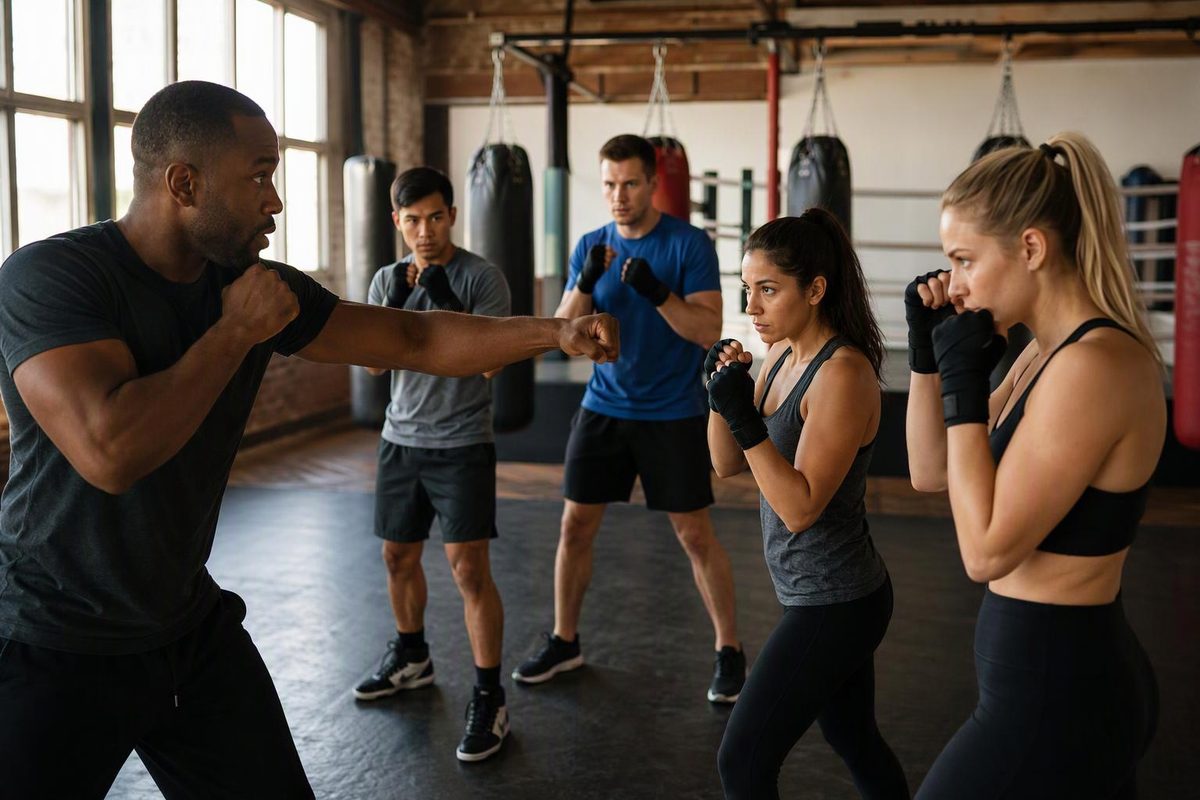
A good boxing class for beginners teaches you to stand, move, punch and defend without rushing you into contact. Choose a technique-focused class for structured instruction, a non-contact fitness class if conditioning is your priority, or a competition-focused program only if you want a path toward supervised sparring and bouts.
Choose your goal and contact preference to identify the right type of beginner class.
Choose structured instruction in stance, footwork, straight punches and defense. You can decide about contact later.
Non-Contact Fitness
Conditioning, shadowboxing, bags and pads without sparring.
Technique-Focused
Structured stance, footwork, punches and defense with fitness work included.
Competition-Focused
Training intended to lead toward supervised sparring and eventually bouts.
Source: USA Boxing membership guidance, Boxing Canada’s beginner reference manual and the England Boxing coaching handbook cited in the article.
These tracks can overlap, but they are not interchangeable. USA Boxing’s fitness membership, for example, allows coached training, heavy bags and mitts but specifically excludes sparring and competition (USA Boxing membership guidance). Before booking, ask whether the gym’s “beginner” class is non-contact, recreational or part of a competitive pathway.
What a Beginner Boxing Class Should Teach
The early sequence matters. Boxing Canada’s beginner coaching manual organizes basic skills from stance and footwork through straight-punch mechanics, the jab, defenses and combinations (Boxing Canada beginner reference manual). England Boxing’s current handbook similarly includes stance, guard, footwork, punches and defenses among boxing’s basic technical skills (England Boxing coaching handbook).
A beginner class should build those skills in an order that lets you stay balanced and protected while adding speed gradually.
Stance and Guard Come First
Your stance should give you a balanced base for punching, defending and moving. A coach should help you place your feet, soften your knees, settle your weight and hold your guard without becoming rigid.
Test the position by taking one short step in any direction. You should finish balanced, with space between your feet and no extra recovery step. If you have to hop, bring your feet back together or make another adjustment, slow down and reset.
Footwork Must Preserve Your Base
Beginners usually learn short steps forward, backward and sideways. Move the foot nearest the direction of travel first, then bring the other foot far enough to restore your stance.
A common fault is bringing the feet together after every step. To correct it, place two parallel strips of tape on the floor. Move slowly along them while preserving the gap between your feet, stopping after each step to check your base. The beginner boxing footwork guide provides a fuller progression.
Straight Punches Reveal Balance Problems
The jab and rear straight let a coach see whether you can punch without leaning, lifting your chin or losing your guard. Your first repetitions may be in front of a mirror or during shadowboxing before you use pads or a bag.
For the jab, concentrate on a direct path out and back rather than power. Keep the other hand at guard and finish in your starting stance. This stance-first jab lesson pairs common faults with corrective drills.
Defense Should Begin With the First Attacks
Defense does not need to wait until you know every punch. A beginner can learn to maintain a guard, move out of range, block or parry a controlled jab and reset after attacking.
A useful class pairs each attack with a responsibility: jab and recover the hand, throw a one-two and finish balanced, or step into range and then make a safe exit. A class that teaches long combinations without showing you how to recover your stance and guard is skipping part of the skill.
What Happens in a First Boxing Class
Formats and class lengths vary, so confirm the gym’s schedule rather than assuming every beginner session follows the same timetable. A well-organized first class will often include:
- Arrival and equipment check: Tell the coach you are new and disclose any injury or limitation that may affect training.
- Warm-up: Begin with easy movement and gradually faster boxing-specific actions.
- Stance and footwork: Use short repetitions with pauses for correction.
- Shadowboxing: Practice without striking equipment or a partner.
- Bag or pad rounds: Throw controlled punches with one clear task per round.
- Conditioning: Complete skipping, bodyweight exercises or a simple circuit adjusted to the group.
- Feedback: Leave with a correction or drill to carry into the next session.
You may feel awkward and tire sooner than expected. Do not respond by punching harder. If your feet begin crossing, your chin lifts or your hands keep dropping, reduce the pace and rebuild the movement cleanly.
A suitable beginner class gives you enough time to understand each drill. You should know what you are practicing, where contact may occur and what signal ends the exercise.
What to Bring to Your First Class
Ask the gym before buying equipment. It may lend gloves or require particular footwear and glove types. A typical first-class list includes:
- Comfortable training clothes
- Clean indoor athletic shoes, if required
- Water
- Hand wraps
- Boxing gloves, unless the gym provides them
- A towel and a separate bag for damp kit
England Boxing’s handbook says hands should be properly wrapped whenever you may strike a partner, pads or hitting equipment. It also says wraps should shape and protect the hand without restricting blood flow (hand-protection guidance). Ask the coach to check your wrapping before you hit anything.
If a wrap causes numbness, feels wrong or makes it difficult to form a fist, stop and redo it. Do not try to solve a poor wrap by forcing your hand into the glove.
If you need gloves, choose them for the work you will do and test their fit over your wraps. This guide explains how to match bag gloves to purpose and fit.
How to Assess the Coach and Gym
A beginner class should be organized enough that you understand the drill, its purpose and when to stop. Look for a coach who:
- Asks about your experience, goals and relevant limitations
- Demonstrates skills clearly and gives specific corrections
- Adjusts drills for different ability and fitness levels
- Teaches balance and defense alongside punching
- Checks wraps, gloves, bags and the training space
- Explains whether a partner drill involves contact
- Does not pressure beginners to spar
If you want contact training or competition, check the gym’s governing-body affiliation and the coach’s current qualifications. England Boxing advises newcomers to use local clubs for learning the basics in a controlled environment, whether they want non-contact fitness or a route toward the ring (England Boxing beginner’s guide).
In the United States, USA Boxing has multiple coach-certification levels. Its membership rules also require coaches to complete background screening and SafeSport training (USA Boxing coach education; membership requirements). Requirements differ by country and program, so ask which governing or certification system applies to that gym.
Be cautious if beginners receive little technical correction, are matched for hard contact or get vague answers about qualifications, first aid and safety procedures. You should also be told before pairing up whether a drill is non-contact, touch contact or sparring.
Sparring Is Optional and Should Not Be Rushed
Sparring is live partner practice in which both boxers respond to each other. It may be restricted to a particular punch or task, but even “light” sparring involves contact. You do not need to spar to learn basic movement or enjoy fitness boxing.
Before sparring, a coach should assess your control, defense and ability to follow instructions. The gym should explain the drill, intended intensity, matching, protective equipment and stop signal.
England Boxing’s handbook treats sparring as a controlled learning activity. Under that governing body’s system, it calls for suitable matching by factors including experience, weight and height, and limits who may supervise sparring (England Boxing coaching handbook). Those provisions should not be assumed to be the rules in every country or program.
Head contact carries real risk. The Association of Ringside Physicians lists possible concussion signs and symptoms including headache, nausea, vision problems, confusion, dizziness, balance trouble and slowed responses. It also notes that concussion can occur without a knockout (combat-sports concussion consensus).
Stop contact immediately and obtain appropriate medical assessment if concussion is suspected. Do not try to push through symptoms or return to the same drill because there was no knockout.
A Useful Target for Your First Month
Do not judge a beginner class by how many combinations you memorize. A better sign of progress is whether you can:
- Find your stance without repeated adjustment
- Move in four directions without crossing your feet
- Throw a jab and rear straight without leaning
- Return both hands to guard
- Use one simple defense and reset
- Complete controlled rounds while preserving your technique
That foundation gives later combinations somewhere to live. Let the coach correct one fault at a time, and add speed only when you can finish each action balanced.