
Boxing Movements: Stance, Steps, Punches and Defense
Learn basic boxing movements in order, with stance, footwork, punching and defensive cues, common-fault fixes and a short solo practice plan.
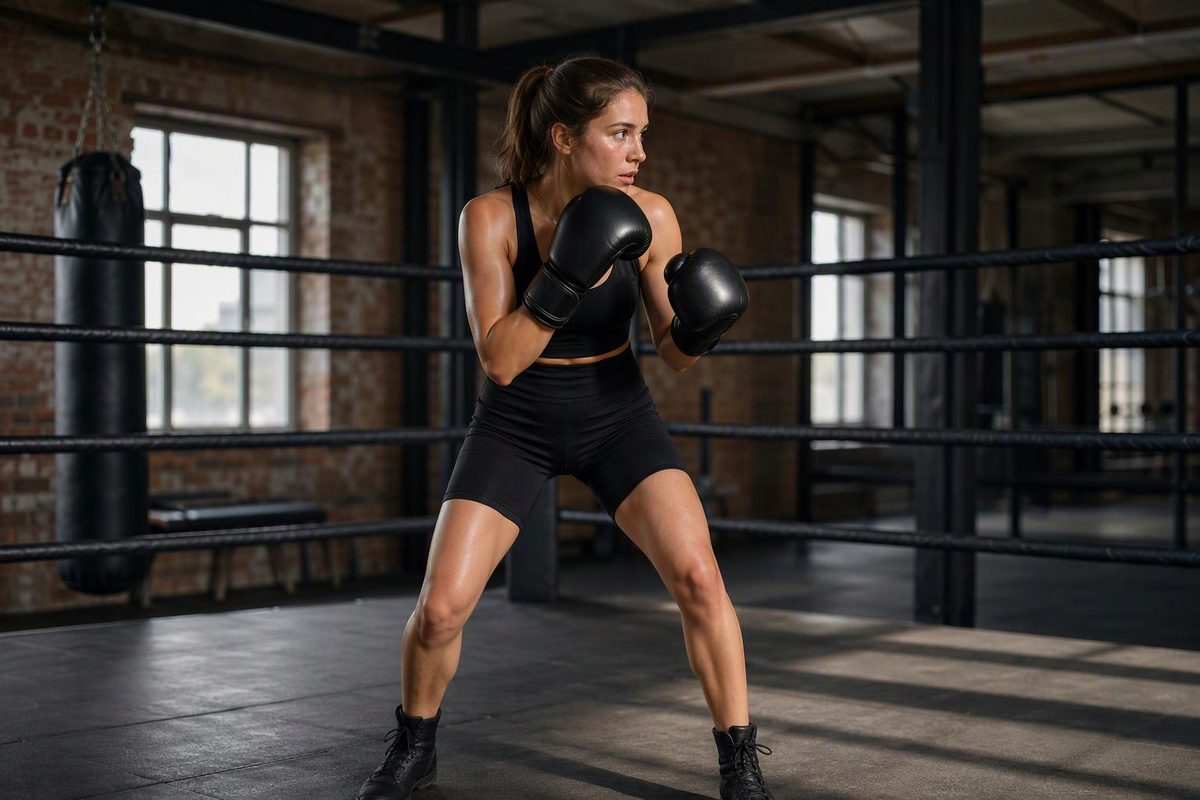
The basic boxing movements are short steps, turns, punches and defensive actions performed from a balanced stance. Start by keeping your position while moving, then add punches and defense without losing it.
The useful test is not how busy you look. It is whether you can finish a movement with your guard in place, see the target and move again without rearranging your feet.
1. Set your stance and guard
Your lead hand and foot are the ones in front; your rear hand and foot are behind. An orthodox stance has the left side leading. A southpaw stance has the right side leading.
For a beginner setup:
- Place your feet about shoulder-width apart or slightly wider, with one foot behind and offset—not directly behind the other like a tightrope.
- Soften your knees and keep your rear heel lightly raised.
- Turn your torso partly sideways rather than facing square-on.
- Bring your hands near your cheeks, with your lead hand slightly forward and elbows close to your body.
- Lower your chin gently while keeping your eyes forward and shoulders relaxed.
England Boxing’s coaching handbook emphasizes width and depth between the feet, a relaxed guard and the ability to move in any direction.
Fault → drill: If your feet line up, mark two parallel tracks on the floor with securely stuck tape. Place one foot on each track and practise settling into stance. Check that you can take a small step forward or backward without swaying first.
2. Step without crossing your feet
Start with short step-and-slide movements. Move the foot nearest the direction of travel first, then let the other foot follow to restore your stance:
| Direction | First foot | Following foot |
|---|---|---|
| Forward | Lead | Rear |
| Backward | Rear | Lead |
| Left | Left | Right |
| Right | Right | Left |
Push gently from the opposite foot. Keep your feet close to the floor, with little bounce, and avoid bringing them together. These cues follow England Boxing’s footwork principles: preserve the length and width of your base and use short, smooth movements.
Fault → drill: If your stance stretches or narrows, take one step and freeze. Compare your finishing stance with your starting stance. Make the next step smaller until you can stop in balance, then link the steps smoothly.
Use the beginner footwork guide for a fuller progression.
3. Turn to change your angle
A pivot turns your stance rather than simply carrying it sideways. Start with a small lead-foot pivot toward your lead side—left for orthodox, right for southpaw:
- Lift your lead heel enough to turn on the ball of that foot.
- Move your rear foot around in a short arc as your body turns.
- Finish with the same stance width and depth, facing the new direction.
Keep your hands up and avoid pitching your weight over the lead leg. My Boxing Coach’s pivot lesson identifies forward tilting and failing to lift the pivoting heel as common faults.
Fault → drill: If you fall forward, remove the punch and reduce the turn. Pivot once, pause and check that you can step backward immediately. Do not force a turn through a foot that is stuck to the floor.
4. Add punches without reaching
The four basic punch types are the jab (lead-hand straight), cross (rear-hand straight), hook (a bent-arm punch around the side) and uppercut (an upward punch).
Begin with the jab and cross. Extend the jab from your guard and bring it straight back. For the cross, turn your rear foot, hip and shoulder together without tipping forward. Keep the non-punching hand in guard.
Punching is not just arm movement: England Boxing’s punch-mechanics guidance connects the punch to the floor, stance and body rotation, and stresses returning to guard.
Fault → drill: If you lean after the cross, practise one slow jab–cross in the air and freeze after recovering your guard. Can you step backward without first shifting your weight? If not, reset your feet and repeat with less forward lean and less rotation. Do not chase an imaginary target by reaching.
Learn hooks and uppercuts separately before adding them to sequences; the types of punches guide explains their paths.
5. Build defense from feet and guard to head movement
Start with a balanced step back and basic hand defenses. A block intercepts a punch with your guard; a parry redirects it with a small hand movement. For basic hand defenses against straight punches, avoid a wide swipe or reach, as England Boxing’s hand-defense guidance explains. See the parrying guide for the rear-hand parry against a jab.
Head movement comes next:
- Slip: Use a slight knee bend and torso turn to move your head off a straight punch’s line. Keep it small and maintain your guard. England Boxing recommends learning the outside slip before the more advanced inside slip—and says slipping should not be the beginner’s first defense. An outside slip takes your head outside the attacking arm’s line, rather than toward the opponent’s free hand.
- Roll: Bend through your legs and move your head through a shallow U-shaped path beneath an imagined hook, then return upright. Keep looking forward. My Boxing Coach’s rolling lesson warns against dropping the hands or bending at the waist instead of using the legs.
Fault → drill: If you look at the floor during a roll, face a mirror and practise one shallow roll at a time. Keep your eyes on your reflection and hands near your cheeks. Reduce the depth until you can maintain both.
A short solo practice
Clear a non-slip space with room to step and turn—an explicit precaution in England Boxing’s home shadow-boxing guidance. Warm up gently, then try three two-minute rounds, resting a minute between them:
- Stance and steps: Move in four directions. Pause occasionally to check foot spacing. Add a small pivot once your steps stay balanced.
- Punch and exit: Throw a slow jab–cross, recover your guard, then step back or sideways.
- Defense and reset: Practise a step back, a small parry motion and, if already learned, a slip or shallow roll. Reset after each action.
This is a suggested practice structure, not a fitness test. Keep the pace easy enough to notice faults; shorten the rounds if your form deteriorates. Stop if movement causes pain or dizziness.
These are non-contact drills. Solo practice rehearses positions, not the timing needed against real punches. Have a boxing coach check your technique before progressing to partner contact or sparring. For more round ideas, use the shadow-boxing guide.