
Box on the Inside Without Smothering Your Work
Build inside-boxing skills with balanced entries, compact hooks and uppercuts, active defense, clean exits, and staged beginner drills.
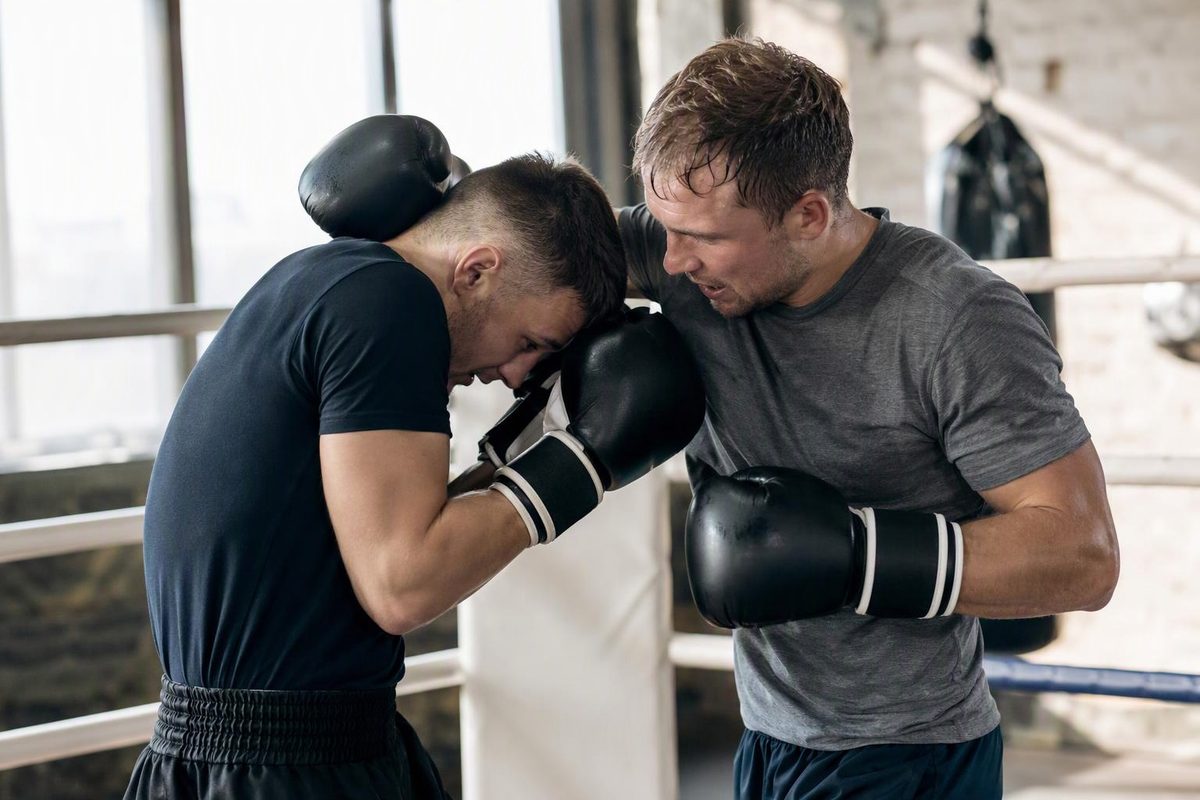
Infighting is boxing at short range, where fully extended straight punches have little room and compact hooks and uppercuts become the main tools. The IBA coaching manual defines short distance as the range where the boxers’ gloves almost touch. Effective infighting means entering behind a boxing action, staying balanced while punching and exiting before your position breaks down (IBA Coaches Manual).
Set your current skill level to choose the appropriate infighting drill.
Choose Your Infighting Drill Stage
Use the most conservative answer that describes your technique today.
Complete three 2-minute rounds of entries, compact punches and controlled exits.
Three-Stage Progression
| Stage | Work | Move On When |
|---|---|---|
| 1 | Three 2-minute shadowboxing rounds | Entries and exits finish in stance |
| 2 | Three 60-second bag rounds; rest 60 seconds | Short combinations and pivots stay balanced |
| 3 | Coached light partner drill; switch after three repetitions | Coach controls readiness and intensity |
Source: progression and round lengths from this guide; short-range technique follows the IBA Coaches Manual.
Build a Stable Close-Range Position
Start from your normal stance. If that stance is not yet stable, work through the beginner footwork progression before adding close contact.
At short range:
- Keep your feet under you rather than spreading them wide.
- Soften your knees and keep your weight between both feet.
- Keep your chin down, eyes up and head slightly off the center line.
- Bring your elbows near your ribs without squeezing the guard shut.
- Stay upright enough to see and move. Do not fold at the waist or look at the floor.
Your stance may become more compact or somewhat squarer than it is at long range. The exact position depends on the exchange, but your feet should not drift onto one line, cross or spread so far apart that you must recover your balance before punching or exiting.
Position check: Have a partner apply a light touch to either shoulder while you hold your stance. Reset your base if you must cross your feet or take a large recovery step to remain upright.
Enter Behind a Jab, Feint or Defensive Move
Walking straight into close range gives the other boxer a clear target. Cover the entry with a jab, feint, defensive movement or angle.
A basic jab entry follows four steps:
- Begin at jab range.
- Touch with the jab while taking one short step forward.
- Bring the rear foot with you so your base does not become stretched.
- Finish with your head slightly off center and both hands ready.
Do not dive beyond your lead knee. Your feet should bring your body into range; your upper body should not arrive first.
For solo practice, shadowbox the entry without imagining an opponent who remains stationary. Jab, step in, settle briefly, then pivot or step out. The goal is to arrive in a position from which you can punch and defend, not to cover the greatest possible distance.
Throw Short Punches Instead of Cramped Long Punches
A close-range hook or uppercut should follow a compact path. Keep the elbow bent, turn through the hips and shoulders, and return the glove directly to your guard. The IBA manual’s hook and uppercut instructions similarly call for a bent elbow, protection from the non-punching hand and a quick return along a short path (IBA Coaches Manual).
Start with this simple heavy-bag sequence:
- Rear uppercut to a body-height target.
- Lead hook to a body- or head-height target.
- Small pivot toward the lead-hand side.
- Reset in stance.
Keep your first sessions light. Connect the feet, trunk and hands without winding up or trying to drive the bag backward.
Punch check: Your punches should land cleanly without shoving the bag away. If the bag’s size and mounting are suitable but it swings sharply after every punch, reduce the power and check for pushing, reaching or a long wind-up.
Defend During Every Close-Range Exchange
Close range does not remove the need for defense. It reduces the available space and time, so defensive movements must become smaller.
- Keep the free hand at your cheek while punching.
- Use your elbows and forearms to cover the body.
- Roll under hooks by bending your knees rather than dropping your eyes and bowing forward.
- After two or three punches, change the angle or leave range.
Do not wait behind a closed guard through a long exchange. Covering is a brief response that should lead to a counter, pivot or exit.
A useful beginner pattern is cover–two–exit. Receive two light glove taps on the guard, return two controlled taps to coach-selected targets, then pivot away. Learn it as a cooperative partner drill rather than open sparring.
Infighting Does Not Mean Holding or Wrestling
Close-range boxing still requires legal punches and active positioning. Holding, wrestling, pushing, locking an opponent’s arm or head, and holding while hitting are not substitutes for inside technique.
The USA Boxing National Rule Book revised January 1, 2026 lists those actions as fouls. It also prohibits failing to step back when the referee orders a break (USA Boxing Rule Book). Those provisions govern USA Boxing competition; other systems may word or apply their rules differently. Follow your coach and the rules governing your bout.
Think touch, punch, turn rather than grab, shove or lean. If the position collapses into a clinch during practice, stop and reset instead of wrestling for space.
Follow a Three-Stage Infighting Progression
Stage 1: Shadowbox Three 2-Minute Rounds
Mark a line on the floor to represent the edge of close range.
- Round 1: Jab-step in, settle, then step out.
- Round 2: Enter, throw two short punches, then pivot out.
- Round 3: Add a compact cover before the two-punch return.
Move at a pace that lets every repetition finish in stance. Remain at this stage if your feet cross, your head reaches beyond your lead knee or you need an extra step to recover after the exit.
Stage 2: Work Three 60-Second Heavy-Bag Rounds
Stand close enough to land with bent arms.
- Throw only two- and three-punch combinations.
- Move your head off center before or after each combination.
- Pivot away and re-enter instead of remaining planted.
- Rest for 60 seconds between rounds.
Use properly fitted wraps and suitable bag gloves. The guide to choosing and using bag gloves covers the equipment checks.
Stay at this stage until you can enter, land compact punches and leave without reaching, pushing the bag or losing your stance. More power does not compensate for an unstable position.
Stage 3: Add a Coached Partner Drill
Wear the equipment required by your coach, agree on the permitted targets and keep contact light.
- Boxer A enters behind a jab and gives two controlled glove taps to the assigned targets.
- Boxer B catches or covers, then returns two controlled taps.
- Both boxers pivot out and reset.
- Change roles after three repetitions.
Only add unrestricted close-range sparring when a coach considers both boxers ready. Contact work carries risks that solo drills do not, so it requires supervision, an agreed intensity and clear stopping rules. The same planning principles used for boxing sparring preparation apply here.
Correct Infighting Faults One at a Time
Reaching With the Upper Body
Shadowbox the entry with your lead shoulder over your base. If your head arrives before your lead foot, shorten the step and slow down. Do not add punches until you can enter without falling over the lead knee.
Throwing Wide, Looping Hooks
Work close to the bag at low power. Keep your elbow bent and stop each punch when it reaches the target line. Return the glove directly to your guard rather than letting it circle back.
Losing Your Stance
Place two short tape marks on the floor for your feet. After each combination, stop and check that your feet have not crossed, landed on one line or spread too far apart.
The marks are a reference rather than a position you must preserve rigidly. Your stance can adjust as you enter and pivot, but it must continue supporting your weight and next movement.
Looking Down During Contact
During a no-punch partner drill, keep your eyes on your partner’s upper chest while both of you take small steps. Add light glove taps only when that visual habit remains steady.
Looking down makes it harder to track punches and movement. Keep your chin lowered without lowering your line of sight.
Remaining Inside Too Long
Limit every bag combination to three punches and require a pivot or step-out afterward. This creates an automatic end to the exchange instead of leaving you planted in front of the target.
For a beginner, progress means arriving balanced, landing compact punches, protecting against the return and leaving under control. A harder or longer exchange is not useful if your stance and defense disappear.